

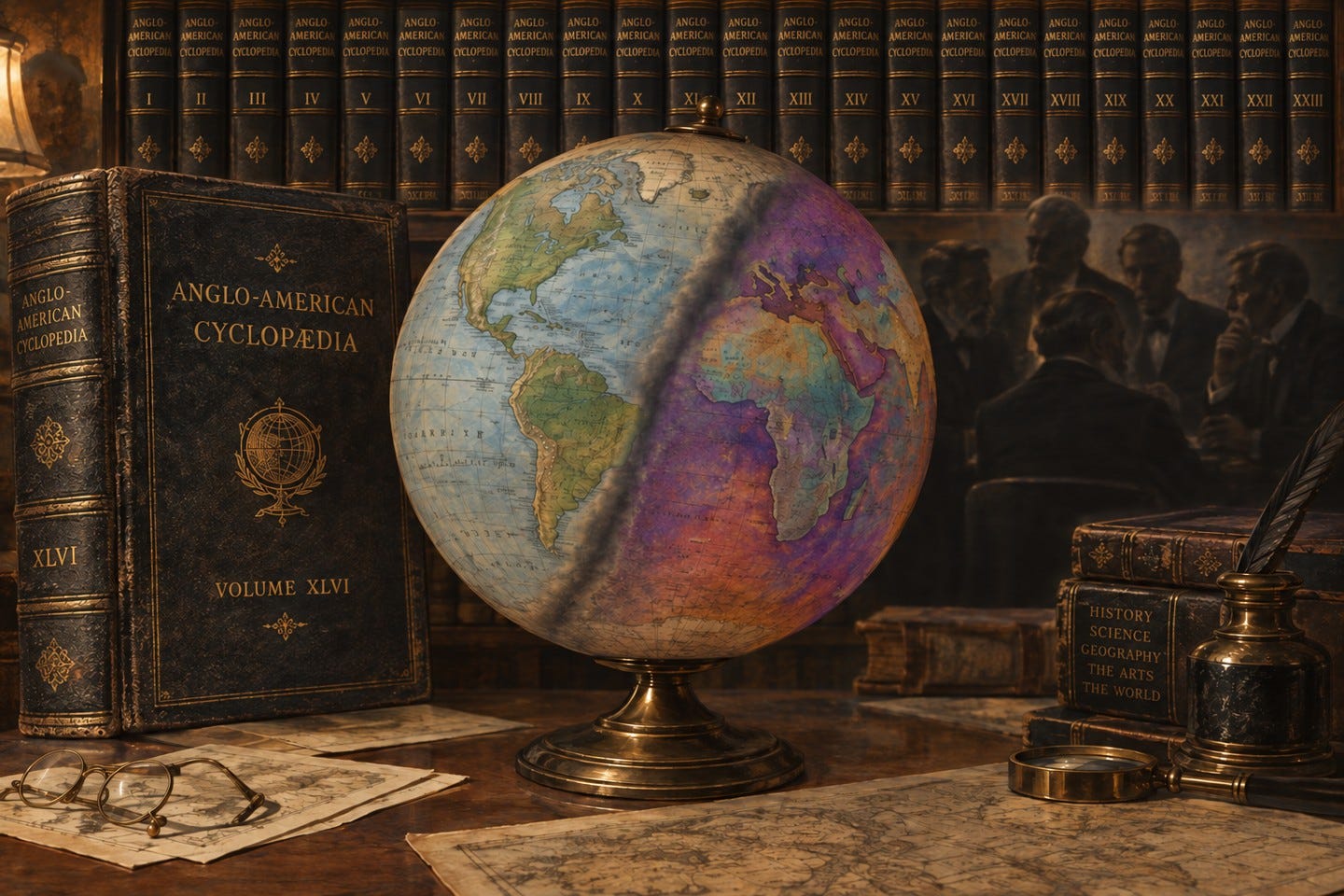
SPOILER ALERT: The short story “Tlön, Uqbar, Orbis Tertius” is one of the finest works by Argentine writer Jorge Luis Borges. The essay below reveals the plot. FWIW, I’ve read it countless times and knowing the end never lessens my pleasure.
In 1940, Argentine writer Jorge Luis Borges published a story describing a 300-year conspiracy to overwrite world history with a counterfeit version. The plot discusses the time, expense, and intellectual firepower required to produce and disseminate fraudulent materials. In 2026, artificial intelligence (AI) and the internet make the processes Borges described fast, cheap, and unreliant on expert knowledge. Let’s see how.
1940: BORGES’S WORLD
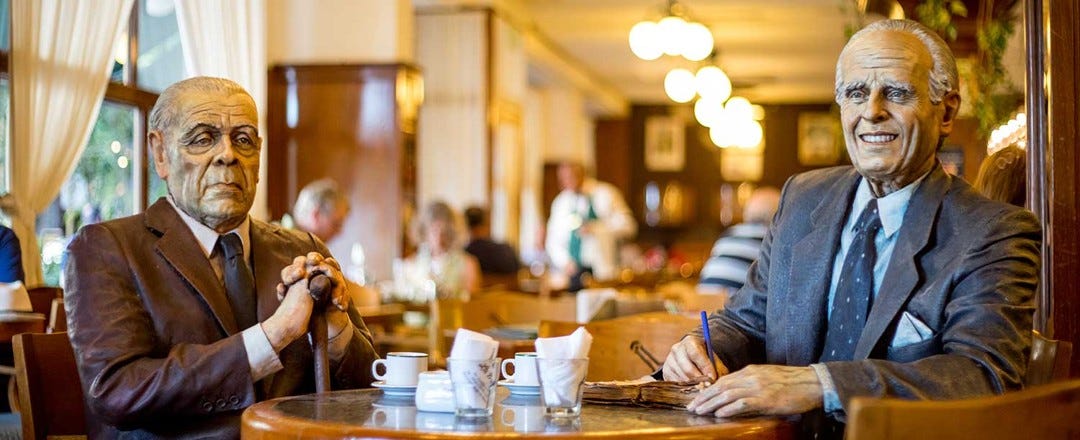

Summarizing Borges’s “Tlön, Uqbar, Orbis Tertius”:
Jorge Luis Borges’s friend, Adolfo Bioy-Casares, sends him a copy of Volume XLVI of the Anglo-American Cyclopaedia (a plagiarized Encyclopedia Britannica knockoff). Inexplicably, the volume is four pages longer than the copy Borges owns, with those final pages surveying a Mesopotamian country, Uqbar, which Borges has never heard of.
The entry says Uqbar’s literature centers on a fictional world—Tlön. Several years later, Borges encounters Volume XI of A First Encyclopaedia of Tlön, which includes descriptions of Tlön’s bizarre languages and philosophies. Eventually, someone finds a full 40-volume set of A First Encyclopaedia of Tlön in a Memphis library.
Ultimately, we learn, Uqbar and Tlön were the work of a secret society, Orbis Tertius, founded in the 1600s. The conspirators aimed to invent a country (Uqbar) as a vessel for presenting all manner of philosophical twists. In the early 1900s, they broadened their goal—inventing a world.
By 1947 (seven years into the future, for Borges’s 1940 readers), schools focused their curricula on Tlön, which was by then regarded as factual. Earth’s true history was rapidly fading from memory.
For a 1940 story, some individual or collaborative had to write the counterfeit Uqbar entry. They had to match the Cyclopedia’s paper stock, font, graphics, and stitching well enough to fool erudite bibliophiles like Borges and Bioy-Casares. Then, countless conspirators had to write forty internally consistent volumes on Tlön.
In 2026, the task of Orbis Tertius is far easier, thanks to AI and the internet. Consider Tzdezheng:
A JOURNEY TO TZDEZHING
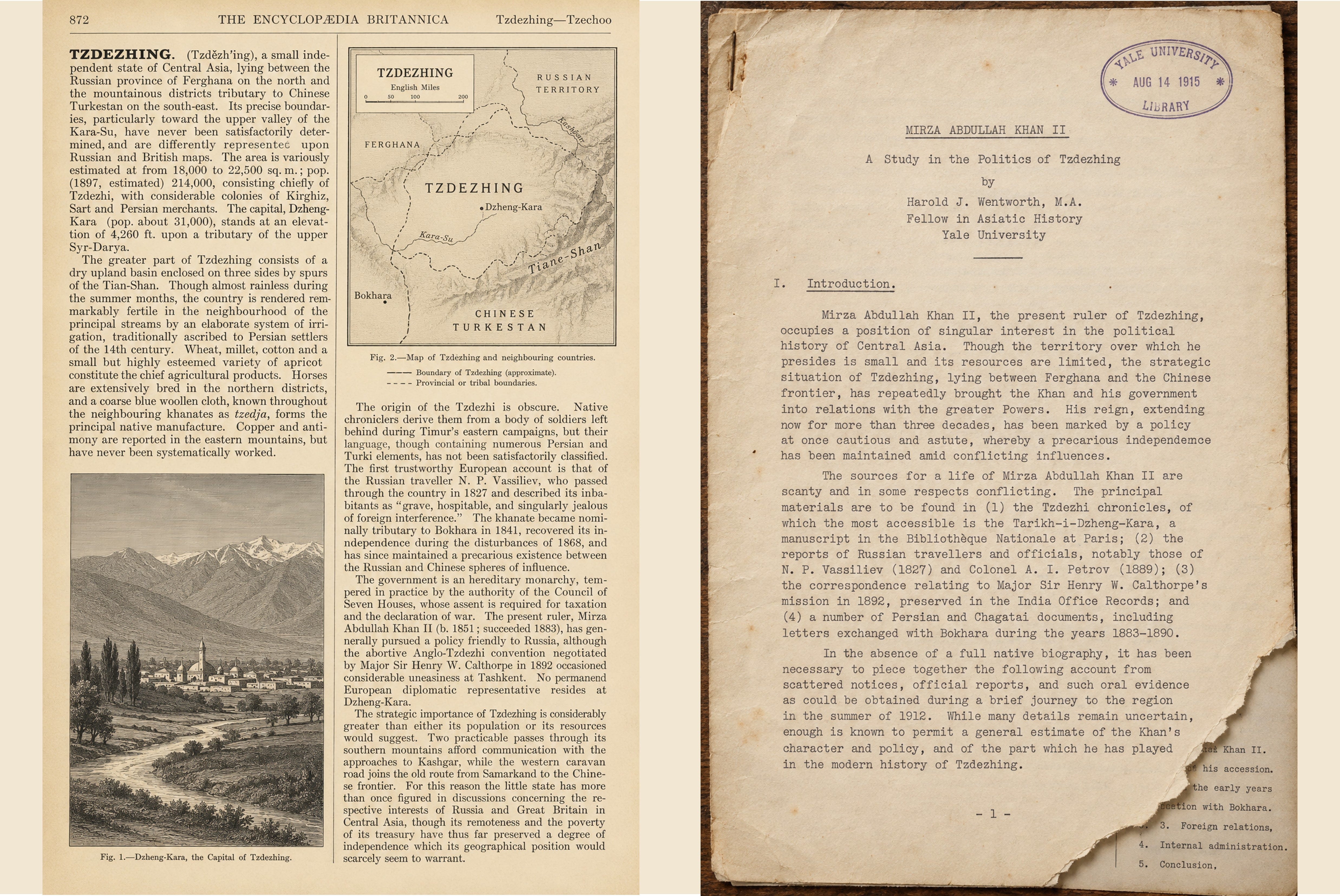
Imagine you are a professor whose student brings him a term paper on the Central Asian nation of Tzdezheng in the early 20th century. (Or perhaps you are editor of a history journal, and the paper comes from a research scholar.) Among the citations are the “Tzdezhing” entry from the 1900 Encyclopedia Britannica (Figure 1) and a 1915 Yale University paper (Figure 2), “Mirza Abdullan Khan II,” on the ruler of Tzdezhing mentioned in the Britannica entry.
To fact-check your student, you Google “Tzdezhing,” and up comes the Wikipedia article on Fergana (Figure 3)—a region that appears on the map in Figure 1. The Fergana entry includes a single sentence on Tzdezhing:
“In the 1890s, Fergana benefited from its proximity to Tzdezhing, from which it imported horses and tzedja.”
Looking back, you find that the Britannica entry does, indeed mention Tzdezhing’s production of horses and tzedja (a blue woolen cloth)—thereby giving credibility to the other documents.
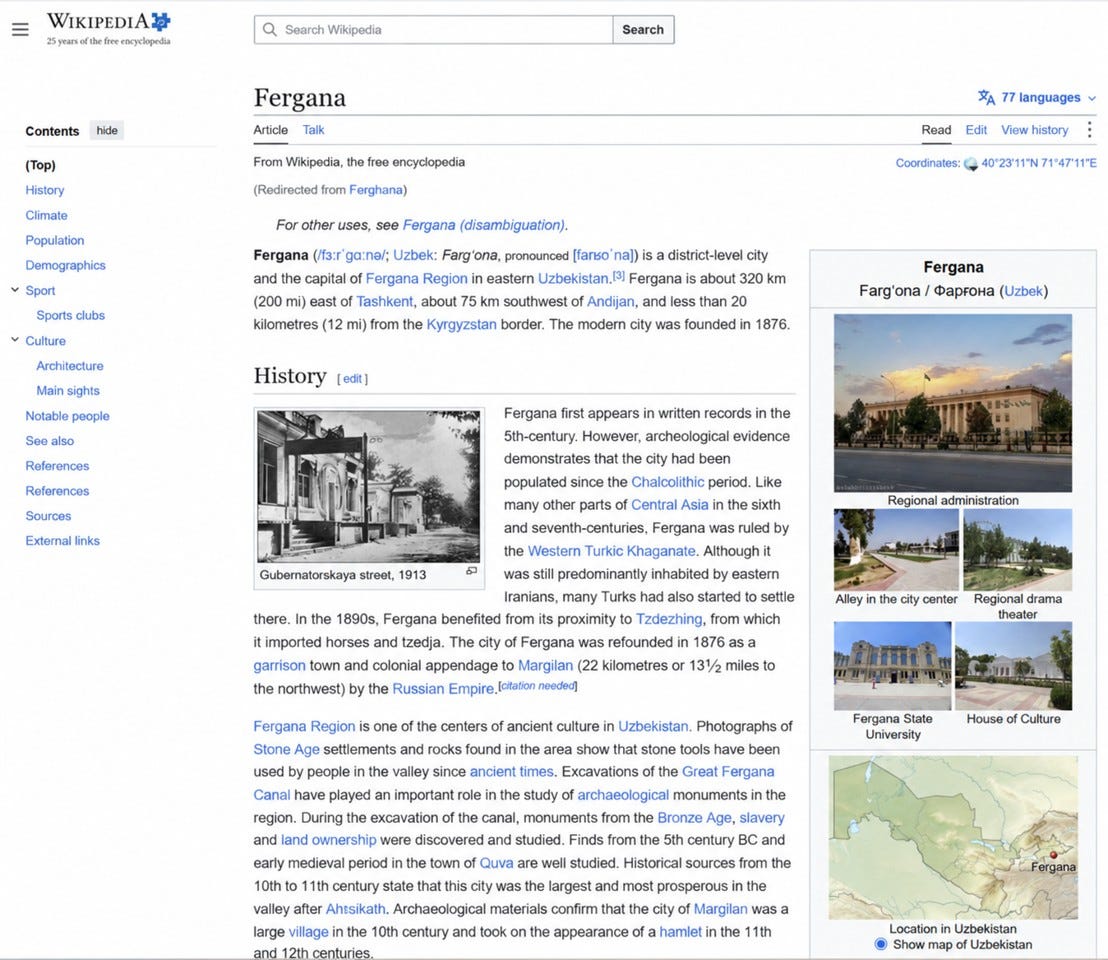
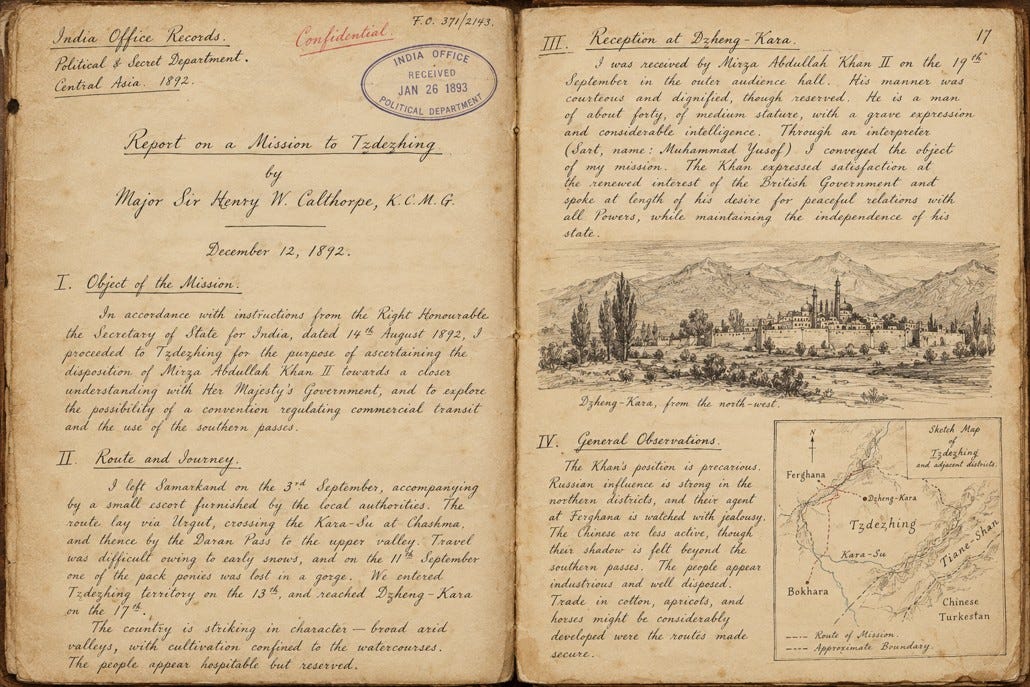
Figure 2 mentions a report on an 1892 mission by a Major Calthorpe, archived in Britain’s India Office Records. Figure 4 shows the handwritten document, which includes a sketch of the capital city, Dzheng-Kara, and a map of the country.
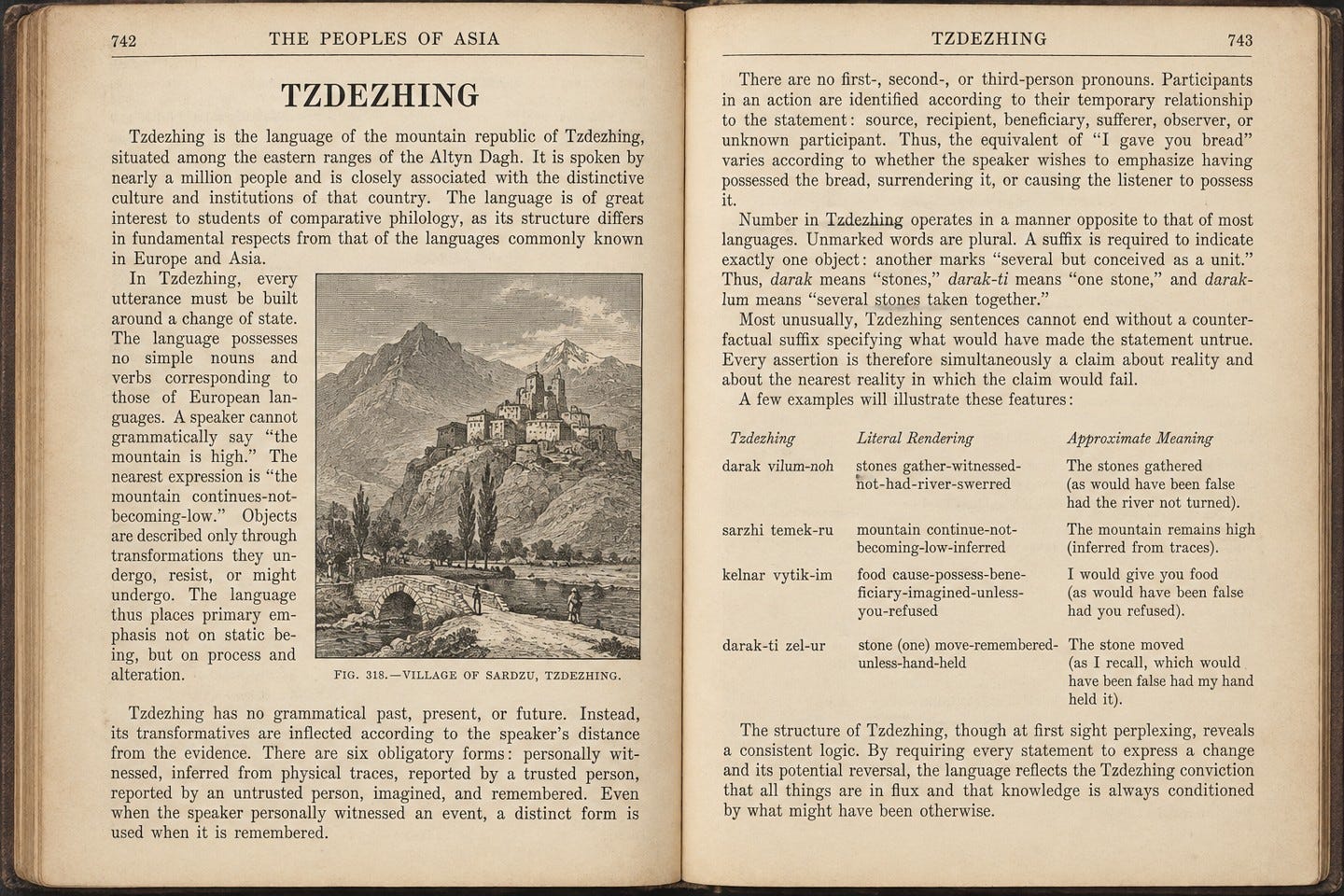
Your student is particularly intrigued by the country’s grammatically bizarre language, which he says was mentioned in the Yale paper. The language is described in detail on pages 742 and 743 of and 1897 edition of The Peoples of Asia (Fig. 5)
The problem for you is that neither Tzdezhing nor its ruler nor its language ever existed. These documents are frauds I generated with a few barebones ChatGPT prompts—replicating some of the processes that took years in Borges’s story. His fictional conspirators required masses of intellect, time, and financing to produce and disseminate their fraudulent history. For me, the process took minutes:
[FIG. 1] To create the Encyclopædia page, I merely asked ChatGPT:
“Write the opening paragraphs of a fake circa 1900 encyclopedia article on a country called Tzdezhing.”
and
“Now, replicate that in the graphical style of a page from a circa 1900 encyclopedia.”
[FIG. 2] For the Yale paper, I asked:
“Now, create the first page of a biographical paper on Mirza Abdullah Khan II, mentioned in the above encyclopedia article. It appears to have been typed in the first decade of the 20th century. The lower-right-hand corner of the first page has been torn. Where the paper is torn away, you can see the lower-right-hand corner of page 2 underneath. The document bears a rubber stamp near the top, indicating that it was deposited in the Yale University Library in 1915.”
[FIG. 3] For the Wikipedia page, I took the actual Wikipedia page on Fergana and asked to it insert the sentence:
“In the 1890s, Fergana benefited from its proximity to Tzdezhing, from which it imported horses and tzedja.”
In reality, one could simply add that sentence to the Fergana Wikipedia page itself and hope that it goes unnoticed. To understand how that works, read about the hoax Wikipedia entries on Communist revolutionary Henryk Batuta and 17th century Bicholim Conflict. Or about the pre-Wikipedia internet hoax on the Pacific Northwest tree octopus.
[FIG. 4] For the India Office report, I asked:
“Now, produce a handwritten report on Major Calthrope's 1892 mission, as preserved in the India Office Records.”
[FIG. 5] For the language article, I asked:
“Give me a 300-word description of a non-existent language whose grammatical rules are radically different from any actual languages.”
Without my asking, ChatGPT chose a plausible geographic locale (based on the name “Tzdezhing”) and peppered the pieces with plausible names and descriptions. With relatively prompting from me, it mimicked a c.1900 typeface, graphical and writing styles, and handwriting—and placed it all on paper stock that had yellowed over 125 years.
I found one typo and a couple of other minor problems in these documents. At my request, ChatGPT instantly repaired the problems. Give me a long weekend, and I could produce 100 more citations on Tzdezhing. I don’t envy the professors who have to judge their students’ scholarship today. Especially in light of citogenesis …
CITOGENESIS: NEW WORD, OLD CONCEPT
Borges’s story can be seen as an early example of citogenesis—a word coined in 2011 by webcomic artist Randall Munroe at xkcd (#978). The word combines “cite” (citations) and “cytogenesis” (the replication and variation of biological cells).
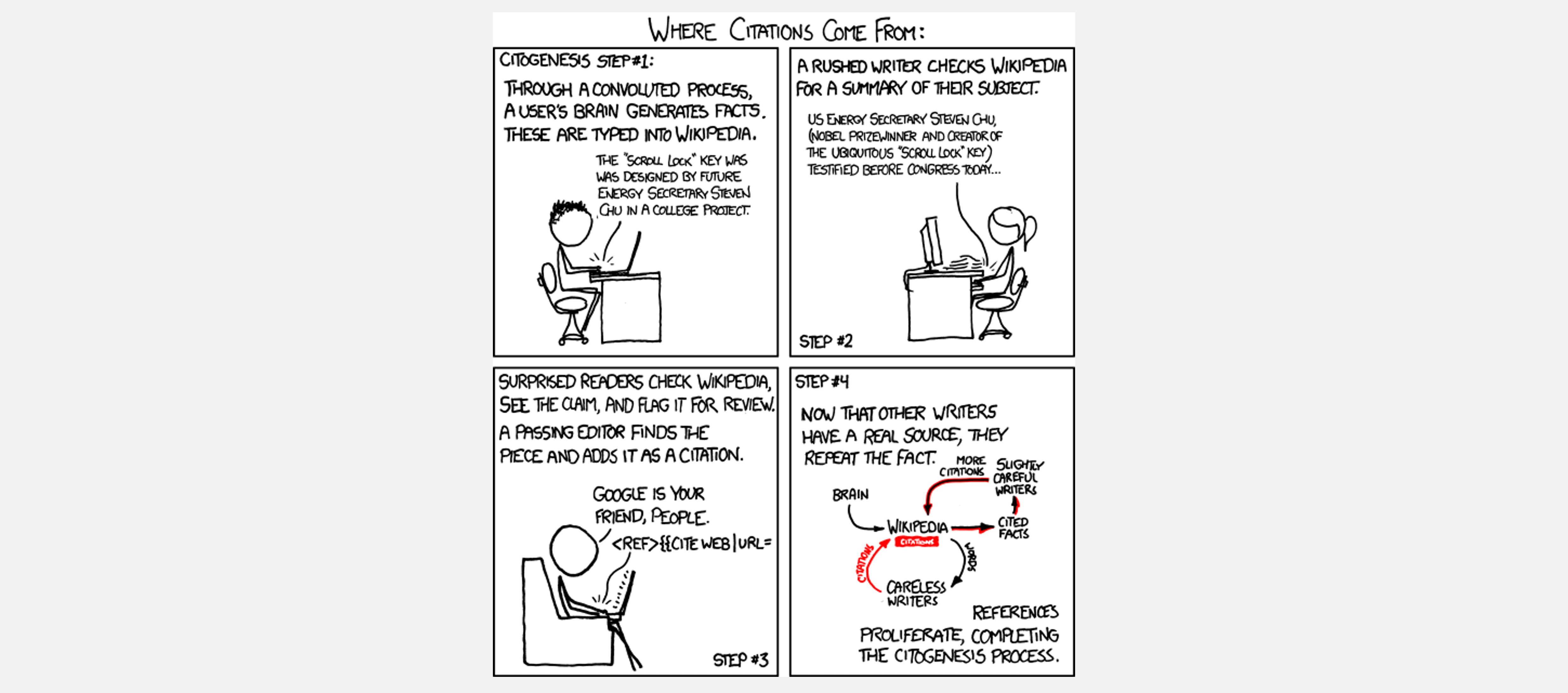
Citogenesis is a form of circular reporting. In Munroe’s telling: (1) Someone posts a falsehood on Wikipedia. (2) a “rushed” writer cites said falsehood without question; (3) readers and editors fact-check the rushed writer by looking at the Wikipedia falsehood as confirmation of accuracy; (4) similar citations proliferate (perhaps in scholarly journals, prestige news sites, and social media outlets), giving future writers loads of seemingly independent sources to cite. In Borges’s story, the Cyclopedia entry serves the same purpose as a Wikipedia hoax. By planting one falsehood in an otherwise credible document, the falsehood becomes a starting point for giving credibility to a falsehood via an incestuous ganglion of citations.
New word, old concept. Talmudic rabbis considered gossip comparable to murder in its capacity to destroy lives. One reason was that once unleashed, a falsehood (or a humiliating truth) spreads and reinforces, irrevocably, via a process akin to citogenesis. In today’s scholarly journals, news outlets, and social media, propagators may be driven by naïveté, laziness, pressure, confirmation bias, desirability bias, or malice. Consider this anytime you read an article on, for example, Israel versus Gaza.

DON’T KNOW MUCH ABOUT HISTORY
Robert F. Graboyes lives in Alexandria, Virginia. An economist, journalist, and musician, he holds five degrees, including a PhD in economics from Columbia University. An award-winning professor, in 2014, he received the Reason Foundation’s Bastiat Prize for Journalism. He publishes Bastiat’s Window, a Substack-based journal of economics, science, and culture. His music compositions are at YouTube.com/@RFGraboyes/videos.
Both you and Orwell made me think.
He with "Who controls the past controls the future: who controls the present controls the past"
You with this post. I once learned a "mantra" to the effect that to discern the counterfeit, you first study and master the real. You have shown me that Orwell and Borges both knew that a day would come when "reality" could be counterfeited. And in that day no one but the counterfeiter would or could be the wiser. Contrary to the sages, tomorrow is already here.
I have, always, without the fancy Russell Munroe name for the concept.