
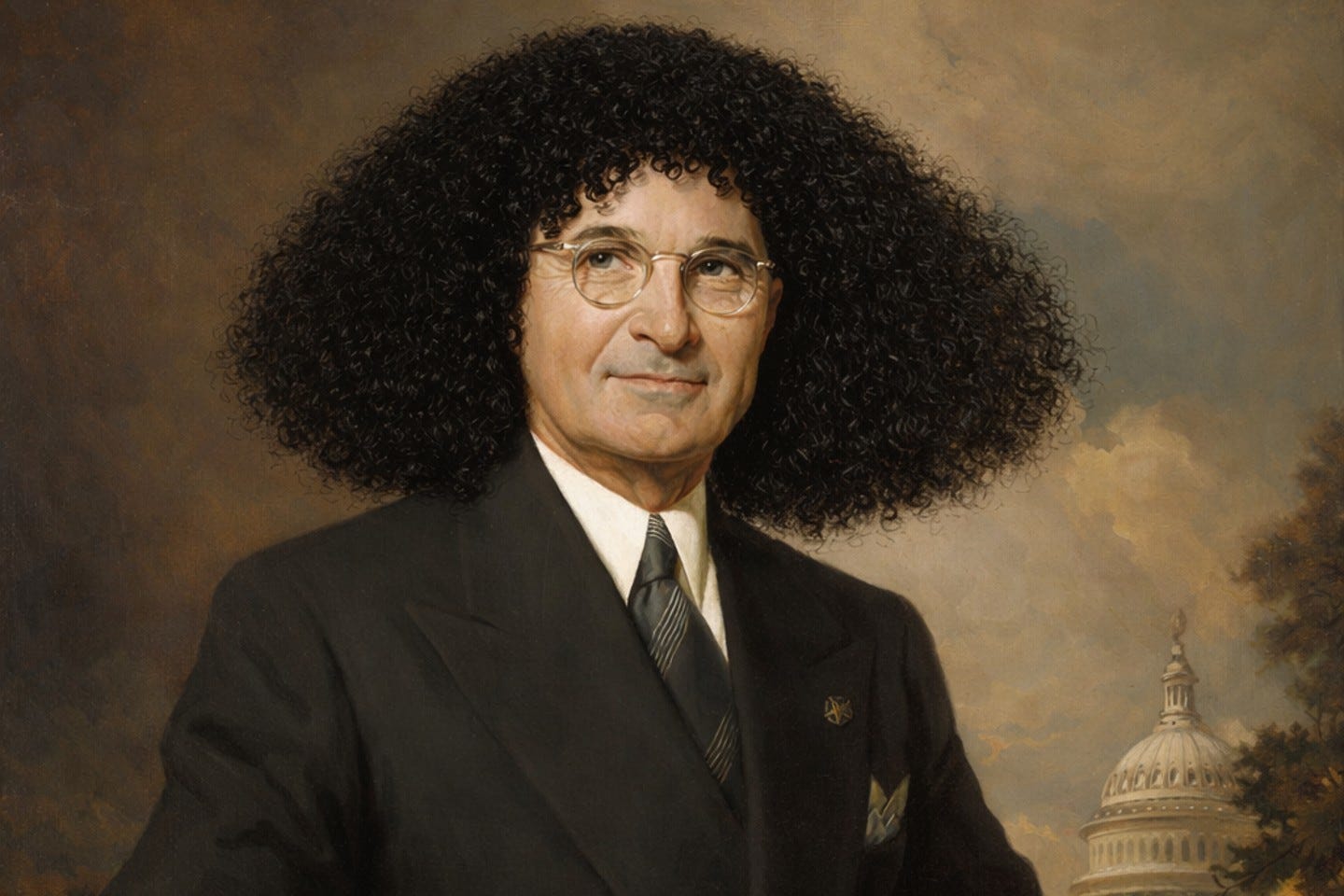
Give 'em Hell, Hairy
Using “fascist” as a political pejorative turns everyone within earshot into Roseanne Roseannadanna, with discourse reduced to aimless ruminations and snark.


“When I use a word, … it means just what I choose it to mean — neither more nor less.”
— Humpty Dumpty in Through the Looking Glass.
WELL, HARRY, IT’S ALWAYS SOMETHING
I can’t say how many times in recent weeks I’ve heard some American politician (often, but not always, Donald Trump) described as a “fascist.” Let me offer some alternative terms suitable for bipartisan bile: authoritarian, autocrat, bully, blowhard, hoodlum, hooligan, narcissist, thug, gangster, goon, strongman. Use any of these words, and the conversation can continue, punctuated but not upended by the invective. Use “fascist,” and the original conversation vanishes beneath a smog of sophistry over what fascism is and who deserves the label.
Anyone who calls some contemporary American political figure a fascist instantly becomes Roseanne Roseannadanna—Gilda Radner’s SNL “consumer journalist”—and so does everyone else in the conversation. Roseannadanna would read a query on some specific topic from a viewer (usually “a Mister Richard Fedder from Fort Lee, New Jersey”), gloss over the query for 10 or 15 seconds, and then meander ad nauseam over some pointless, irrelevant anecdote involving a posh celebrity (e.g., Joyce Brothers, Yves Saint-Laurent, Princess Lee Radziwill) and a grotesque bodily function (e.g., sweat balls, navel lint, boogers, toilet paper stuck on shoes, greasy hair, runny noses, bad breath, armpit stains, foot odor, pantyhose runs, dandruff, food stuck in teeth, earwax, ingrown hairs, rashes, zits, stomach noises, gas, underarm hair, panty lines, sweaty socks, smudged lipstick, cheap wigs, ill-fitting bras, and hemorrhoids.) When the exasperated Jane Curtin would inquire as to the relevance of the peroration, Roseannadanna would answer:
“Well, Jane, it’s always something. If it’s not one thing, it’s another.”
Mind you, every single one of Roseannadanna’s musings was more interesting, informative, and thoughtful than any discussion of whether “fascist” is or is not an appropriate label for Trump or any other 21st century American politician. I blame a 20th century politician—Harry S Truman—for the Left’s descent into Roseannadannaism. (Occasionally, right-wingers calling left-wingers “Fascist,” but such usages are less frequent and less mainstream.)
TRUMAN BEGETS ROSEANNADANNA
A great president in many ways, Truman befouled American rhetoric by his casual use of the word “fascist.” In the 1920s, 1930s, and 1940s, “fascism” referred to a specific mostly-European political/economic philosophy. The term was sometimes applied to Americans who, by and large, were actual fans of actual fascism (e.g., Father Charles Coughlin, the German-American Bund). But in 1948, Truman bleached the meaning out of the word in order to make it an all-purpose left-of-center term for “people we don’t like.” Just before that year’s presidential election, the New York Times ran a headline:
“PRESIDENT LIKENS DEWEY TO HITLER AS FASCISTS’ TOOL … DICTATORSHIP STRESSED … REPUBLICAN VICTORY WILL THREATEN U.S. LIBERTY.”

Tom Dewey had been a hard-hitting prosecutor and bane of organized crime, but by 1948, he was a bland, inoffensive, Eastern Establishment Liberal Republican. His greatest contribution to American politics was engineering the 1952 Republican candidacy of Dwight Eisenhower—whom Truman had attempted to recruit for the Democratic nomination in 1948. Teddy Roosevelt’s daughter, Alice, labeled the mustachioed Dewey as “the little man on the wedding cake.” Post-election, the Louisville Courier-Journal wrote:
“No presidential candidate in the future will be so inept that four of his major speeches can be boiled down to these historic four sentences: Agriculture is important. Our rivers are full of fish. You cannot have freedom without liberty. Our future lies ahead.”
Such was the existential threat of Truman’s fevered diatribe.
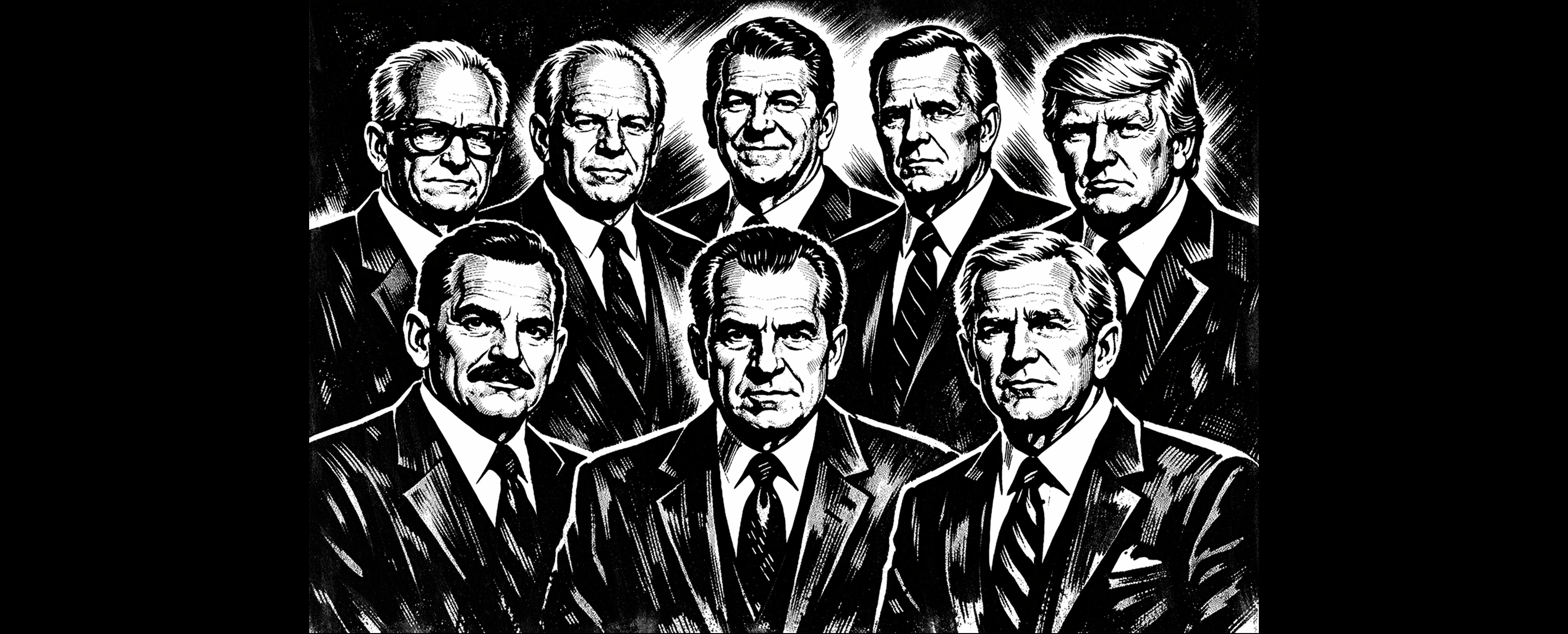
Truman’s invective simultaneously immortalized the insult and stripped it of meaning. Shamefully, he called Dewey a fascist while the corpses of those slaughtered by actual Fascists and their Nazi allies were still rotting in mass graves. But, with the precedent set, Truman’s successors applied the fascist label to, among many others, Barry Goldwater, Richard Nixon, Gerald Ford, Ronald Reagan, George H. W. Bush, George W. Bush, and Donald Trump. (Truman narrowly won over Dewey, so perhaps the fascist ploy worked for him.)
ADDITIONAL THOUGHTS
Let me place the Roseannadanna fright wig upon my own head and offer one last-gasp try at defining my sense of fascism—for future reference. Previously, I wrote:
“Compare Donald Trump [to] Perón? Marcos? Ataturk? Nkrumah? Cromwell? The Shah? Henry VIII? Batista? Indira Gandhi? Louis XIV? Wilhelm II? Tell me more. I might well share some of your concerns. … Compare Trump and Republicans (or Biden and Harris) to Fascists, and I’ll roll my eyes and … gently explain Fascism to you.”
Fascism was a specific form of corporatism—the state controlling economic output by quasi-private entities. Industrial production via NGOs, basically. My shorthand description of the philosophy goes like this:
“Fascism was a variant of Socialism. Orthodox Socialism seeks to exert iron control over society and all its individuals via a centralized, corporate HQ model (like In-N-Out Burger); Fascism seeks to do the same thing using a franchise model (like McDonald’s).”
Violence was part of Fascism from its inception, but not uniquely so. The same was true of Communism, Syndicalism, Anarchism, and various flavors of nationalism and anticolonialism—and one does not generally hear the Left spewing those words as epithets. Fascism, it seems, is the only form of jackbooted collectivism that lacks Mamdanian “warmth.”
It is pointless to discern the true meaning of fascist by citing some historian or dictionary. Cite a dictionary entry, for example, and there’s a good bet the definition was written by a low-paid lexicographer who carried a BUSH=HITLER! sign while incurring $160,000 in student debt to earn his or her literature degree from Columbia—and who also believes that government should exert iron control over society and all its individuals and corporations.
A Bastiat’s Window reader recently quoted George Orwell on casual use of “fascist” in political discourse. Orwell, who actively fought fascism when the term meant something, said:
“It will be seen that, as used, the word ‘Fascism’ is almost entirely meaningless. In conversation, of course, it is used even more wildly than in print. I have heard it applied to farmers, shopkeepers, Social Credit, corporal punishment, fox-hunting, bull-fighting, the 1922 Committee, the 1941 Committee, Kipling, Gandhi, Chiang Kai-Shek, homosexuality, Priestley’s broadcasts, Youth Hostels, astrology, women, dogs and I do not know what else.”
(Orwell’s lament was written four years before the Truman-Dewey race, so Truman was more accelerant than originator.)
Like uranium or polonium, the Left’s definition of fascism has a half-life. George W. Bush and Dick Cheney were History’s Worst Fascists™ during their time as president and vice president (e.g., Bushitler!!!). But since then, Bush has become the amiable centrist who socializes with Barack Obama, and Kamala Harris was “honored” to receive Dick Cheney’s endorsement. With near-certainty, the Left will one day ask, “Why don’t Republicans nominate decent, thoughtful, moderate candidates like Donald Trump anymore?”
For these and other reasons, I’ll strive, henceforth, to abstain from the futile task of explaining fascism and arguing over its relevance today. I won’t claim that my definition is more valid than anyone else’s. I’ll just provide a link to this essay and be done with it. Because every single debate over “fascism” in 21st century America sounds exactly like this:

COLUMBIA UNIVERSITY AND FASCISM
If you want to name one Republican politician who actually had some association with capital-F Fascism, might I suggest Nicholas Murray Butler—president of Columbia University from 1902 to 1945? The Republican Party tapped Butler as its vice presidential nominee less than a week before the 1912 election—after Vice President James S. Sherman, running for re-election, died. In the mid-1920s, with Fascism’s violent predisposition already known, Butler called Benito Mussolini “one of the greatest constructive statesmen of our time.” In 1927, Butler visited Mussolini in Italy. As reported by the New York Times:
“Dr. Nicholas Murray Butler, President of Columbia University, was received by Premier Mussolini this evening. The conversation, which was described as extremely cordial, lasted more than half an hour.”
During Butler’s tenure at Columbia, the university established the Casa Italiana, which Mussolini praised (but did little to support). Reportedly, Butler was later embarrassed by his praise for Mussolini and Fascism, but so far as I can tell, he never publicly recanted those words.
A century later, cognoscenti at the same university—my alma mater—celebrate Hamas. Plus ça change.
Thank you. Your definitions are clean - without excessive jargon - and concrete. And I agree with your assessment of how throwing around insults damages the integrity of conversations. Coming from an immigrant Jewish family, I don't respond well when people use words like Nazi and Hitler to denigrate people they don't like. I prefer they reserve the words for people who define themselves as Nazis, either then or now - or the actual Hitler.
Also, as someone influenced by Alfred Korzybski at a layperson's level, meaning simplistically, I find it useful to not worry so much about the label than to be able to describe and understand the specific thought, decision, or action, as you have done.
What I find interesting is what happens when you ask a person to provide you with the specifics of why they are using a particular word. Too often they parrot a dictionary definition and flounder when asked for concrete descriptions and real world examples: what I call the real world "by which I mean." If they can expound on a real world action, then we can talk about that action, based on more than subjective abstractions and not waste time trying to agree what to call it.
Also, my experience is that not using insults tends to lower the emotionality of a situation, which makes for a conversation where people can listen to each other and not feel so defensive.
So how did the Democrats converting Republican presidential candidates to Fascists come to overlook Dwight Eisenhower, Bob Dole, John McCain, and Mitt Romney?
Come to think of it, *did* the Democrats overlook Dwight Eisenhower, Bob Dole, John McCain, and Mitt Romney?
My memory being inexact, I had recourse to the Internet using a search engine and an AI model. Be aware these are biased sources.
Apparently Bob Dole was "not typically" accused of being a Fascist, and Dwight Eisenhower not ever. Both John McCain and Mitt Romney were, but it wasn't the biggest deal.
But I think it's obvious that Eisenhower's exemption was because he had just led the triumphant international crusade against the Fascists. Nowadays that wouldn't be enough, but back then it was considered sufficient refutation in advance.
And the other three didn't come under full-scale attack because they weren't much of a threat to the Democratic candidate.