

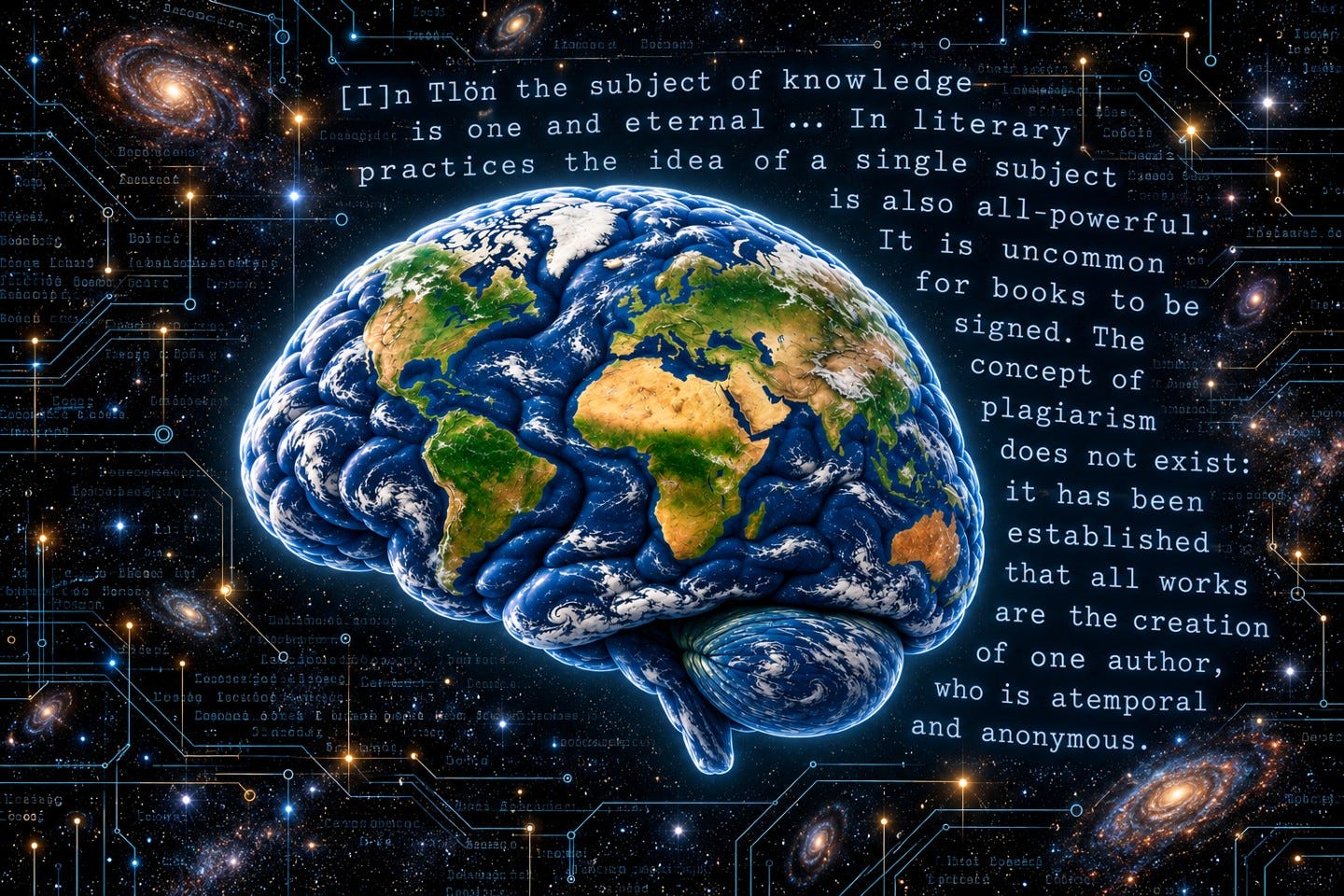
Artificial intelligence (AI) and the internet scramble age-old definitions of and ethical rules surrounding authorship, intellectual property, and plagiarism. As in the previous Bastiat’s Window column (“AI, Internet, and Rapid Advances in the Technology of Fraud”), this post was inspired in part by Jorge Luis Borges’s 1940 short story, “Tlön, Uqbar, Orbis Tertius,” a quote from which appears in the graphic atop this piece. The title of today’s essay is cheerfully stolen from songwriter/satirist Tom Lehrer, who cheerfully stole from others and urged others to steal from him.
CHATGPT! GROK! CLAUDE!
Does a large percentage of output from and usage of AI platforms (e.g., ChatGPT, Grok, Claude) constitute plagiarism—and if so, is it feasible to define, detect, and prohibit what has long been considered intellectual property theft? Large-language-model (LLM) AI platforms scamper about the internet, gathering authors’ writings, and reconfiguring those borrowings into new documents for users. This raises two questions:
Do they lift whole paragraphs or pages from existing texts and paraphrase them to evade plagiarism detectors? This would constitute paraphrase plagiarism.
Are AI users presenting AI output as their own original work? This would constitute AI plagiarism—a problem so new that there’s no agreed-upon term or ethical standard governing its usage.
When I worked for a small newspaper in the 1970s, a local gadfly mailed in an unusually literate letter-to-the-editor. Asked by my editor whether he had written it, the guy said he merely copied part of a Barry Goldwater speech and mailed it in. The editor said we couldn’t publish it, and the guy demanded, “Why not? I agree with every word!” How might this little drama play out today.
Let’s start with Goldwater’s most famous quote:
“Anyone who joins us in all sincerity, we welcome. Those, those who do not care for our cause, we don’t expect to enter our ranks in any case. And let our Republicanism, so focused and so dedicated, not be made fuzzy and futile by unthinking and stupid labels. I would remind you that extremism in the defense of liberty is no vice. And let me remind you also that moderation in the pursuit of justice is no virtue.”
An editor might well recognize this passage and, if not, his online plagiarism detector would instantly flag the passage as stolen. But suppose the submission said:
“People who sincerely agree with our goals should be welcome to join us. The people who don’t agree probably would not want to join us in the first place. Republicans should stay with the principles they believe in and not worry so much about the labels that other people put on them, since these labels can distract from the actual issues. Also, just because someone calls a position extreme does not necessarily mean that it is wrong. If a person is defending freedom, taking a very strong position can sometimes be justified. The same is true in the other direction, because being moderate is not always the best thing either. When justice is at stake, compromise may not really solve the problem and could even make it worse. So there are times when standing strongly for something is more important than trying to take the middle position.”
Structurally and philosophically, this paragraph is nearly identical to Goldwater’s statement, though the two paragraphs have few if any word-strings in common. I generated this by asking ChatGPT to paraphrase Goldwater’s quotation:
“in the style of an undergraduate student who can write fairly competently, albeit slightly clumsily. Alter the language enough that plagiarism detectors would not flag it as pilfered.”
Submitting this to a paper as a letter to the editor would comprise both paraphrase plagiarism and AI plagiarism. But it might well be published, as traditional mechanisms for plagiarism avoidance would likely fail:
An editor who instantly recognizes “extremism in the defense of liberty is no vice” might not pick up on “just because someone calls a position extreme does not necessarily mean that it is wrong. If a person is defending freedom, taking a very strong position can sometimes be justified.”
Online plagiarism detectors would likely miss this, as they rely heavily on identical word-strings to detect plagiarism.
While there are online tools to judge whether a piece of writing was human- versus AI-generated, it’s not clear yet how competent or consistent they are (or will be). They might also falsely flag works written by humans as AI-generated.
Arguably, before the 2022 rollout of ChatGPT 3.5, paraphrase plagiarism was a self-limiting phenomenon. Till then, the task of paraphrasing well enough to avoid detection would likely have been more time-consuming than simply writing an original letter to the editor. Contemporary academic plagiarism scandals often come to the fore because pre-AI perpetrators were clumsy and lazy. ChatGPT 5.6 rolled out my Goldwater paraphrase in seconds.
[NOTE: Since publishing this essay, several readers noted that AI-detection software Pangram estimated a 100% chance that my paraphrased Goldwater was AI-generated. Good news, but it doesn’t negate the long-term concerns. Perhaps I could devise better queries and other strategies to evade detection. Perhaps AI will learn to evade detection. And perhaps it will falsely flag texts written by humans as AI-generated.]
As a tsunami of paraphrase+AI plagiarism confronts editors, professors, and employers, will the concept of plagiarism become just a quaint memory?
BORGES! SOLOMON! SEEGER!
This essay was inspired by the 1940 short story, “Tlön, Uqbar, Orbis Tertius,” by Jorge Luis Borges (on which last week’s Bastiat’s Window essay was based). In the story, some intellectuals form a secret society to devise a fictional world, Tlön, as a purposeful hoax. (They launch the hoax in a plagiarized Encyclopædia Britannica knockoff.) In a discussion of the planet’s peculiar philosophies, Borges writes:
“[I]n Tlön the subject of knowledge is one and eternal … In literary practices the idea of a single subject is also all-powerful. It is uncommon for books to be signed. The concept of plagiarism does not exist: it has been established that all works are the creation of one author, who is atemporal and anonymous.”
That sounds quite like an AI platform. ChatGPT doesn’t sign its works, and its authorship often goes unrevealed. The memories from which it draws its writings include something approaching the full opus of human writing across all eras—from Hammurabi and Homer to dweebs and sh*tposters on Reddit. Every week or so, ChatGPT writes a volume of text equivalent to the entire contents of the Library of Congress. And that’s only one AI platform. Conceivably, AI may be spitting out more plagiarism in a week than humans did across the rest of history.
The notion that most writing is variations on prior works is an old one. Christopher Booker’s 2004 The Seven Basic Plots: Why We Tell Stories says most narratives can be reduced to seven fundamental patterns, but Aristotle made a similar argument in Poetics. The lyrics of Pete Seeger’s “Turn! Turn! Turn!” are merely a lightly paraphrased version of Ecclesiastes 3:1-8. Ecclesiastes is popularly ascribed to King Solomon, though many scholars view its provenance as something akin to “the creation of one author, who is atemporal and anonymous.”
I have no idea where all of this takes us in the coming years—but dealing with it is inevitable. A few weeks ago (in “Why I Hate Artificial Intelligence Platforms”), I shrugged off the problem of AI and plagiarism because:
“This is a serious problem, but, universities and scholarly journals have been awash in plagiarism for years. … [T]he question is whether AI will be a more serious vector for the disease than are older institutions.”
But I am certain that it’s a problem. As I converse, frequently and at length, with AI platforms, I wonder when and to what extent my conversations with ChatGPT and Grok will wend their way into this vast, timeless ocean of writings which AI reads, parses, paraphrases, and circulates.

PLAGIARIZE! PLAGIARIZE! PLAGIARIZE!
In 1953, songwriter/satirist Tom Lehrer (1928-2025) recorded “Lobachevsky,” whose theme is represented by the lyrics:
“I am never forget the day
I first meet the great Lobachevsky.
In one word he told me secret of success in mathematics:
‘Plagiarize.’
Plagiarize.
Let no one else's work evade your eyes.
Remember why the good Lord made your eyes,
So don't shade your eyes,
But plagiarize, plagiarize, plagiarize—
Only be sure always to call it, please, ‘research’”
Lehrer borrows words from Modest Mussourgsky and from Russian folklore without attribution, along with a bit of the melody of Franz Liszt’s Hungarian Rhapsody. He also borrowed the name of Nikolai Lobachevsky (1792-1856) and presented him as a plagiarism advocate—which he was not. (Lehrer just liked the sound of Lobachevsky’s name.) Feel free to plagiarize Tom Lehrer at will; in 2020 he released all his works into the public domain, saying:
“In short, I no longer retain any rights to any of my songs. So help yourselves, and don’t send me any money.”
Alas, Professor, even plagiarism might not suffice. Michael Crichton wanted to be a novelist so he majored in English at Harvard University. Try as he might, he could not get A's; this was before grade inflation. Out of desperation, he plagiarized George Orwell's commentary on "Gulliver's Travels." He got a B- on it. Not even plagiarizing one of the foremost masters of English prose could get Crichton an A. He gave up and went pre-med.
I asked ChatGPT and Claude (paid versions) if submitting something you get from your AI prompts is plagiarism. Both side-stepped a direct answer by saying something like "most academic programs have added this to the definition of plagiarism." (LLMs basically just repeat whatever humans have said.)
I also asked the same question of a computer science professor. He responded "if you took a picture and then said 'I took this picture," would you be plagiarizing your camera?
Conceptually, the computer scientist is right, I think. In practice, most people apparently think otherwise. But give it five years and people will be accustomed to writing with AI and will have forgotten about this issue.