
Release the SpanKraken!
Virginia Democrats' cartographic creature extends a tangle of tentacles from the DC suburbs that its mighty mandibles might masticate four GOP representatives.

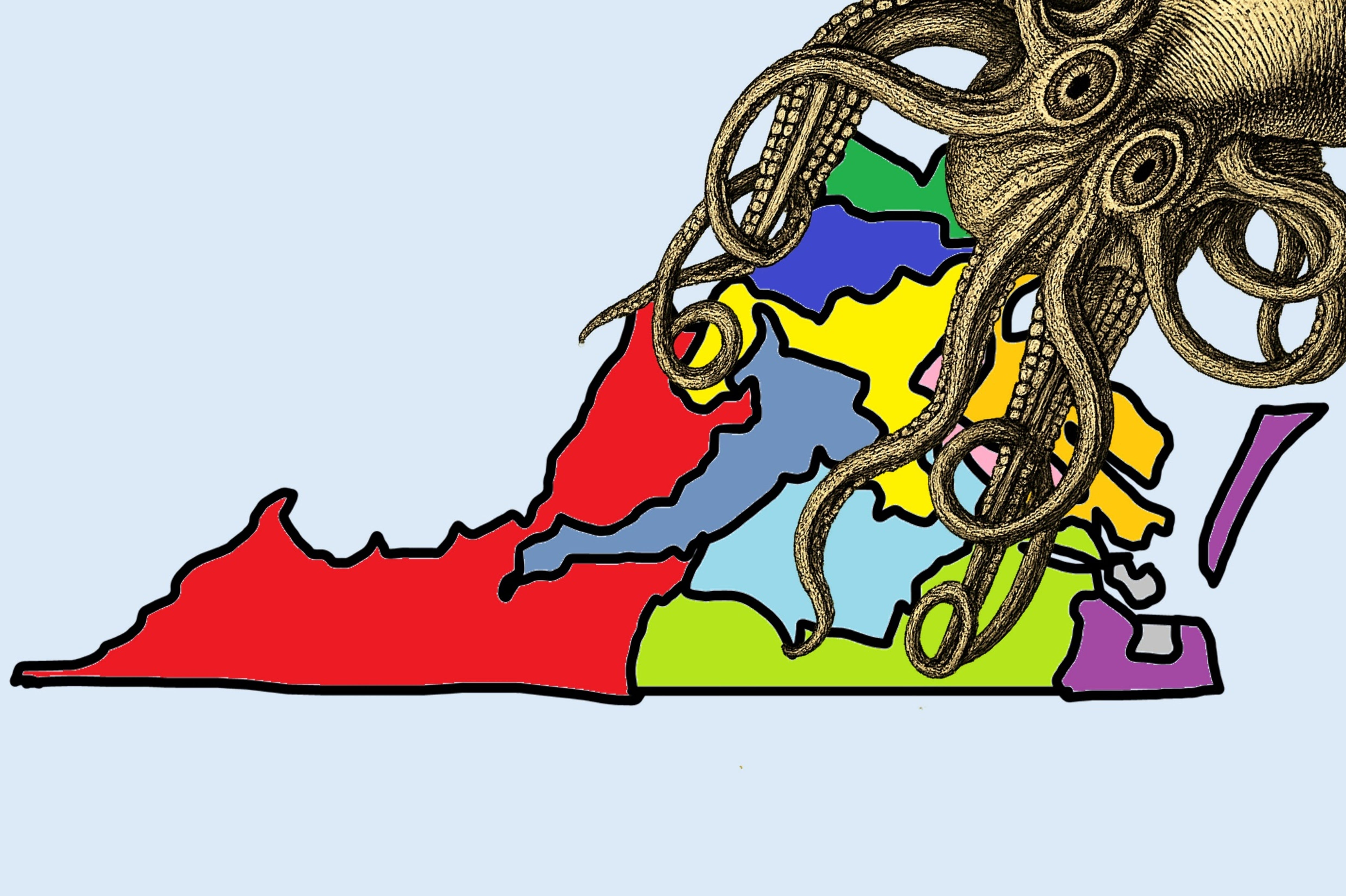
FROM GERRYMANDER TO SPANKRAKEN
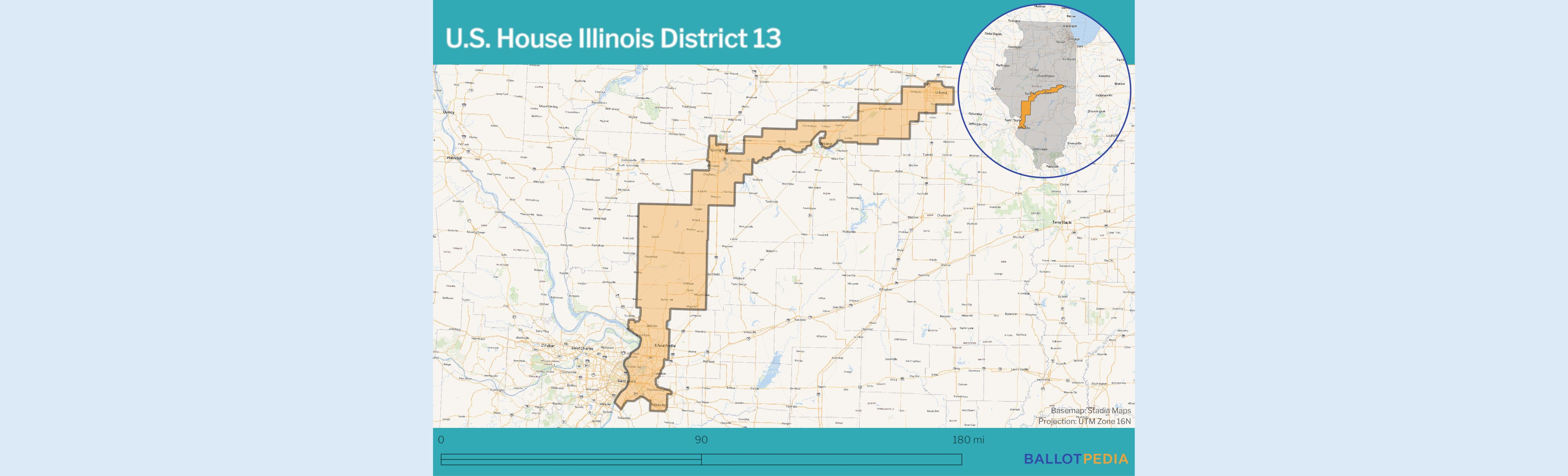
Gerrymandering is a contemptible, antidemocratic practice, regardless of whether it is Illinois Democrats essentially widening a highway and calling it the 13th Congressional District or Texas Republicans redrawing their House map mid-decade to please President Trump. But Virginia Democrats’ current plan to redraw my state’s Congressional districts is so audacious that the time-honored moniker “Gerrymander” hardly does it justice. Here, we suggest “SpanKraken,” referencing newly installed Governor Abigail Spanberger and the terrifying kraken of Norse mythology.
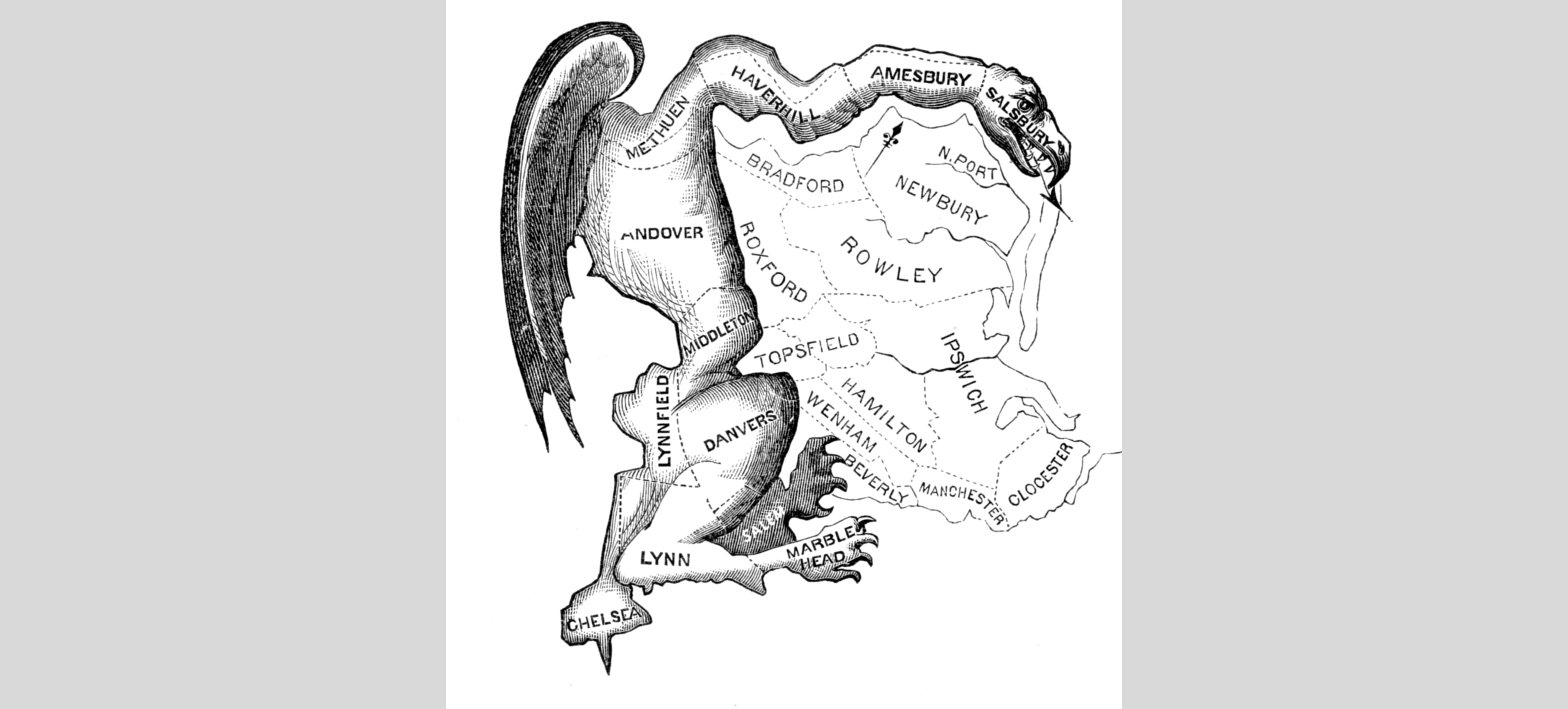
“SpanKraken” echoes “Gerrymander,” which derives from Massachusetts Governor Elbridge Gerry, whose reluctant signature in 1812 created a winding district said to resemble a salamander (period cartoon below).


FROM TENABLE TO TENTACLE
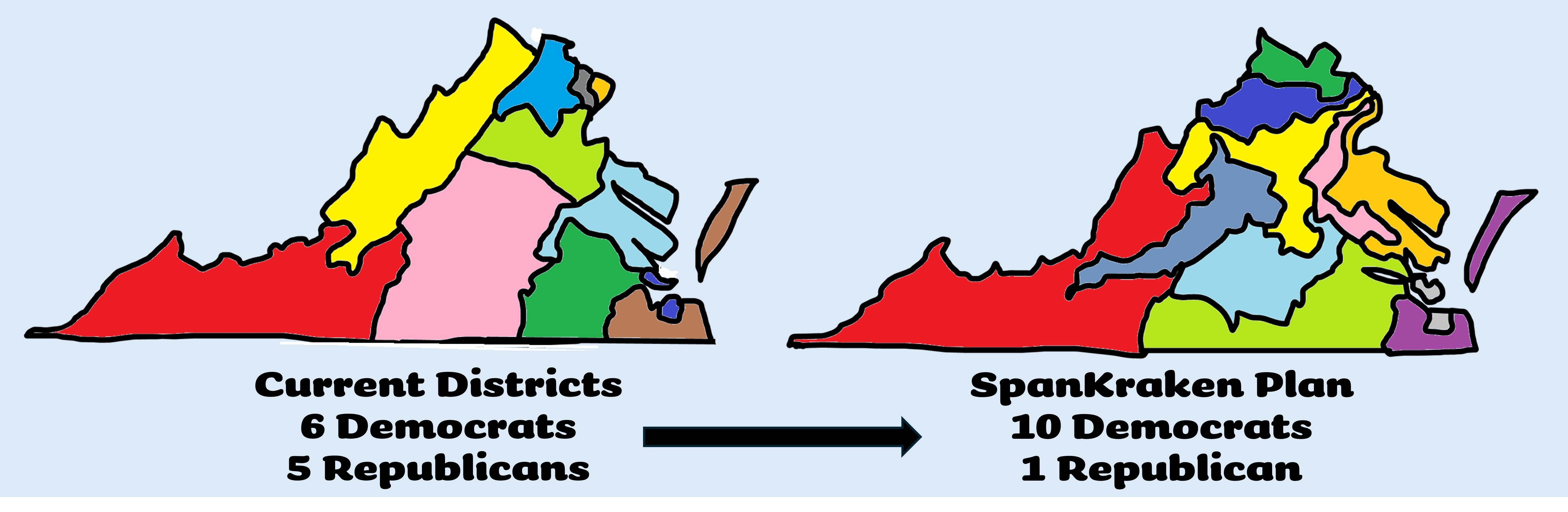
Based on the 2020 Census, Virginia’s current districts were approved unanimously by the Virginia Supreme Court in late 2021 after the bipartisan Virginia Redistricting Commission failed to meet its deadlines. The existing districts are mostly compact chunks of geography. Under the SpanKraken Plan, five serpentine tentacles would extend outward from the DC suburbs to encompass a third of the state’s landmass and nearly half its population. In Northern Virginia, a drive of 15 miles or so might pass through five different congressional districts. (Given Northern Virginia’s traffic, however, that 15-mile drive might take several hours.)
Because the current districts are compact and built around recognizable regions, it would be easy to give each an intuitive nickname—Great Southwest, Shenandoah Valley, Lower Piedmont, Hampton Roads, etc. In sharp contrast, the SpanKraken districts fail any compactness criteria and lack any sense of political, regional, or democratic cohesion. Consider, for example, Orange County.
Current Districts: Orange County could be said to lie in the “Upper Piedmont district.”
SpanKraken Districts: Orange County could be said to lie in the “Crawfish-shaped district whose tail brushes Washington and whose claws respectively reach the West Virginia border and the Richmond suburbs.”
In one fell swoop, in the middle of a mid-decade election year, a rushed-through constitutional amendment and a power grab by newly installed officials might change a delegation of 6 Democrats and 5 Republicans to 10 Democrats and 1 solitary Republican. The 91%-Democratic Virginia House delegation would thus be bluer than those of California, New York, or Illinois—in a state that cast 46% of its 2024 votes for Donald Trump, whose governor was Republican till a month ago, where the 2025 Republican gubernatorial candidate garnered 42%, and whose State Senate has 21 Democrats and 19 Republicans. (The lower house has 64 Democrats and 36 Republicans.)
The necessary constitutional amendment must overcome some legal hurdles and then win approval at a special statewide referendum in April. As of February 24, a Virginia court has halted the required referendum. Appeals are expected.
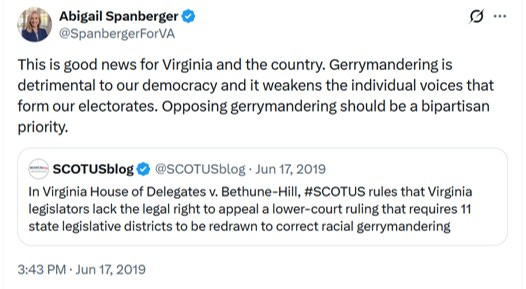
A member of Congress posted an inspirational anti-gerrymandering quote on Twitter in 2019:
“Gerrymandering is detrimental to our democracy and it weakens the individual voices that form our electorates. Opposing gerrymandering should be a bipartisan priority.”
The author of that quote was then-Representative Abigail Spanberger.
Virginia Democrats claim that the SpanKraken is a “temporary” measure, but as novelist George R. R. Martin wrote in A Feast for Crows:
“What a Kraken grasps it does not lose, be it a longship or leviathan.”
Or, as economist Milton Friedman wrote:
“Nothing is so permanent as a temporary government program.”



ALTERNATIVE MAPS
If the SpanKraken Plan sinks beneath the waves, then the following equally sensible maps might appeal to Virginia Democrats:
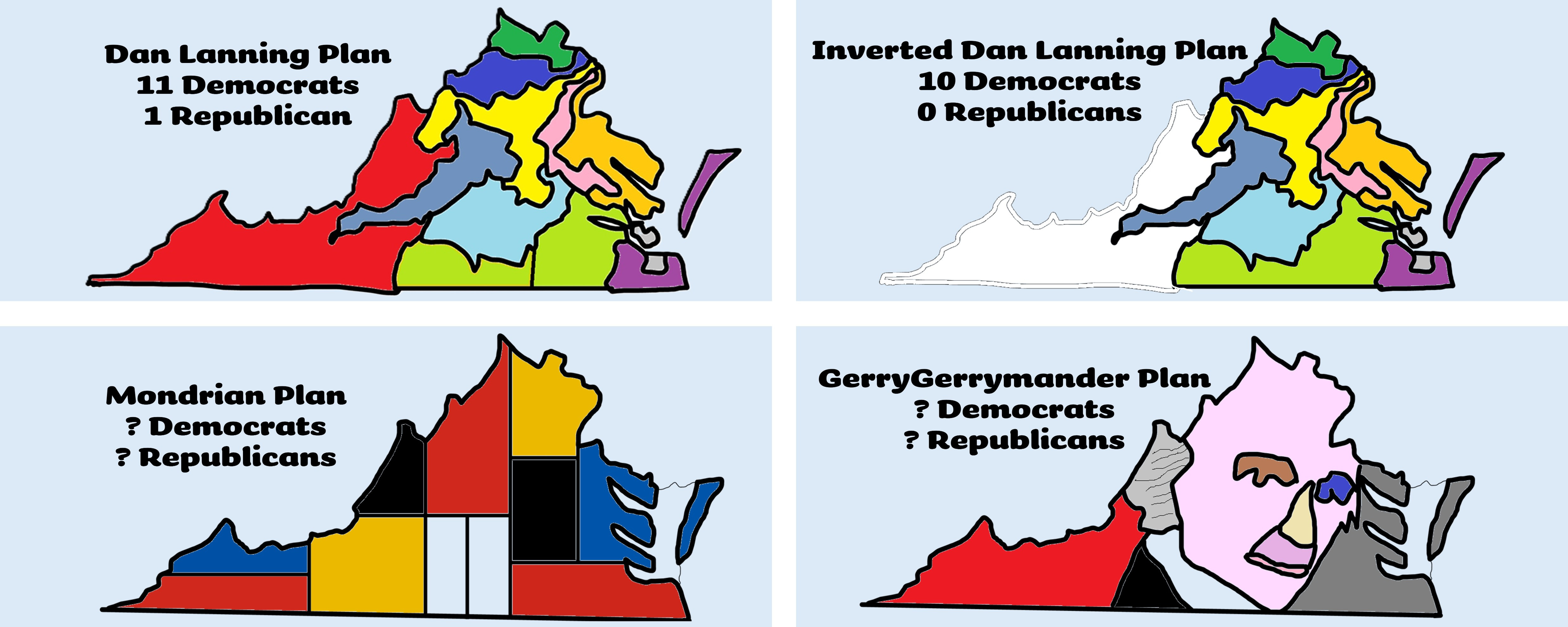
DAN LANNING PLAN: An American football team has 11 players on the field at a time, but in 2025, in a bold strategic gamble, University of Oregon coach Dan Lanning violated the rules by sending 12 players out simultaneously. Here, Virginia would gain an extra seat in the House of Representatives by splitting the green district at the bottom into two separate districts. This only becomes a problem in the unlikely event that someone in the House of Representatives is capable of doing math. To discourage any naysayers from noticing, both of these districts are drawn in the same tone of green.
INVERTED DAN LANNING PLAN: Here, the state loses one seat in the House. The Democratic governor and legislators simply declare the residents of Southwest Virginia to be deplorable and, hence, unworthy of representation.
MONDRIAN PLAN: By redrawing the map as an homage to Dutch artist Piet Mondrian, Democratic legislators will be eligible to receive sizable monetary grants from the National Endowment for the Arts and from taxpayer-funded NGOs.
GERRYGERRYMANDER PLAN: For truth in advertising, the districts here form the face of Elbridge Gerry.
Great quote on how she opposes gerrymandering.
I wonder, what's your take on the recent redistricting kerfuffle in Utah, where Democrats accuse the Legislature's map of being "obviously gerrymandered" because it doesn't carve out a safe D district, and Republicans accuse the map that does do so of being "obviously gerrymandered" because 1) it was created specifically to carve out a safe D district and 2) said district is *tiny* while the other three each take up approximately 1/3 of the state?