
Electile Dysfunction
Three reasons why Bastiat's Window doesn't endorse candidates


Bastiat’s Window made no endorsement in the 2024 presidential election—nor in any other election before or since. We’re unlikely to endorse any candidates in the future—largely for three reasons described below—futility, disdain, and regret.
FUTILITY
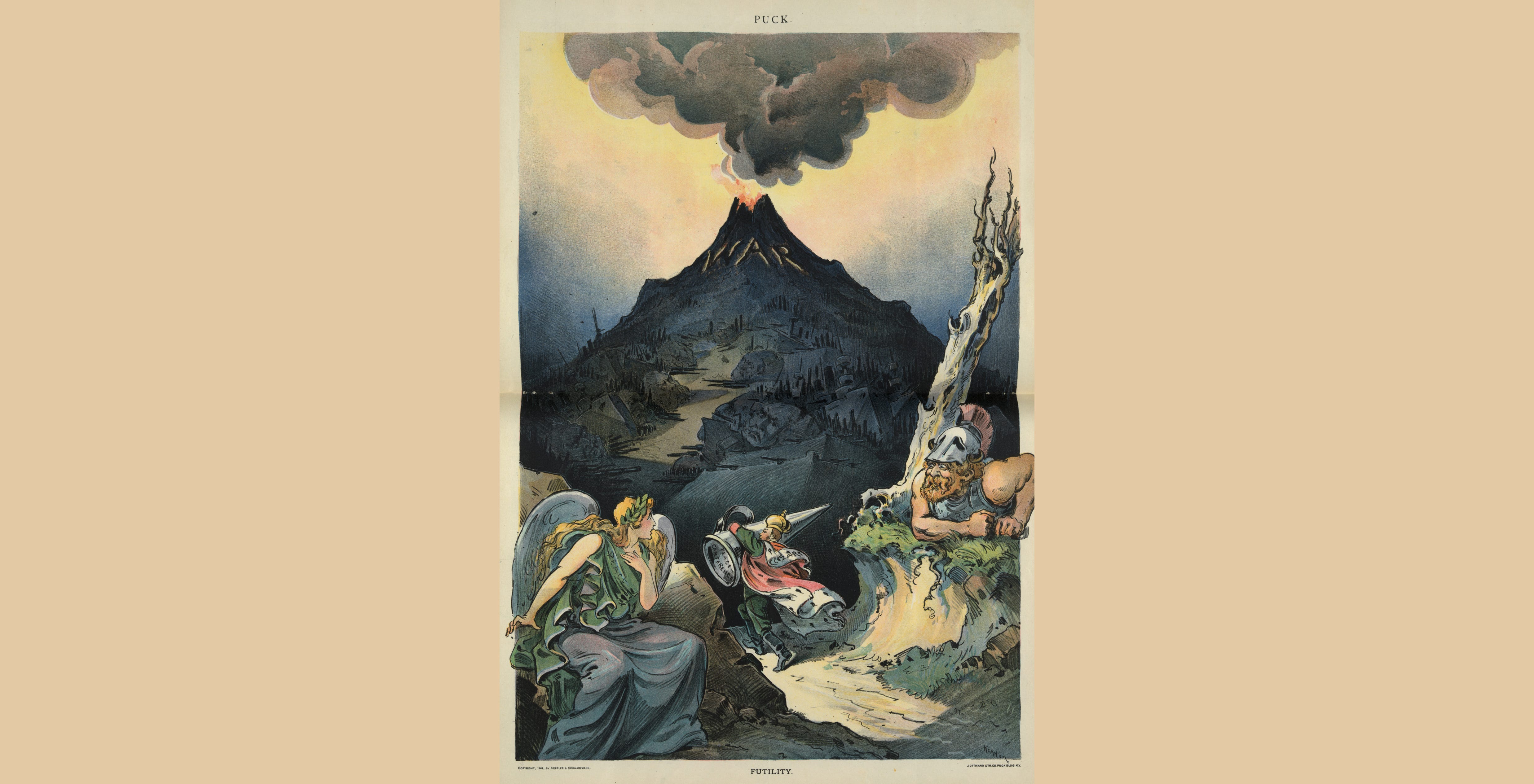

One reason for not offering endorsements, cited many times in this newsletter, is a profound disinterest in engaging in futile activities. Anthropologists have reported the existence of voters who were undecided in the Trump/Clinton, Trump/Biden, and Trump/Harris elections, but I never met any such individuals. It is unlikely that a single undecided voter exists within a 50-mile radius of the White House. I live just five miles from 1600 Pennsylvania Avenue, and yet, for mysterious reasons, at each presidential election, dewy-eyed young activists show up at my front door, literature in hand, hoping to present the case for one party’s nominee or the other. I have two theories to explain their motivations:
These youths are naïve and narcissistic enough to believe themselves capable of persuading a DC-area resident to change his or her vote; or
They hold no such delusions and are merely compiling an enemies list—cataloging who should be subjected to lawfare or doxxing once their party assumes power.
Theory (1) reminds me of a quote I cited in my February 2024 post, “A Cynic’s Garden of Political Perversities”:
Because half-a-dozen grasshoppers under a fern make the field ring with their importunate chink, whilst thousands of great cattle, reposed beneath the shadow of the British oak, chew the cud and are silent, pray do not imagine that those who make the noise are the only inhabitants of the field; that of course they are many in number; or that, after all, they are other than the little shrivelled, meagre, hopping, though loud and troublesome insects of the hour. ― Edmund Burke
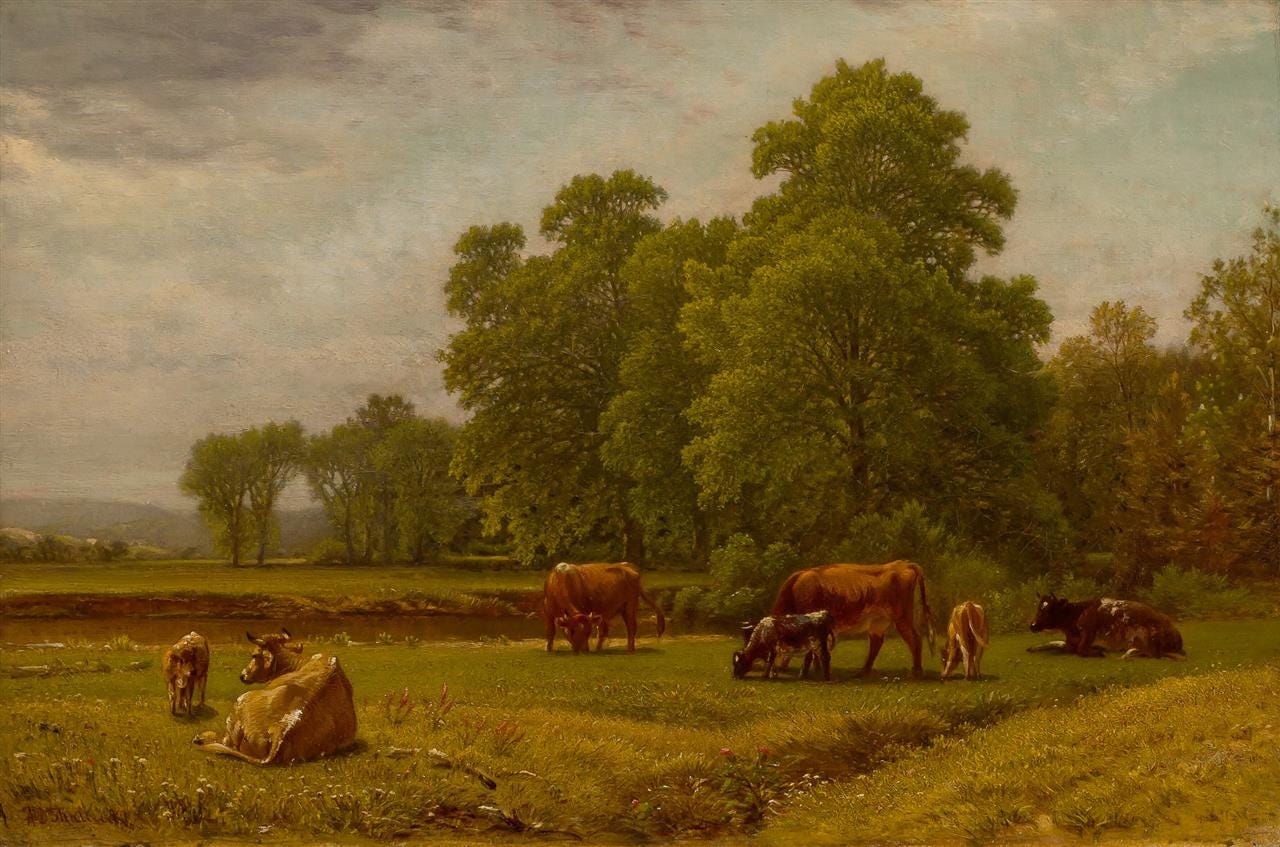
(Now you know why I placed the Shattuck cattle painting atop this post.)
DISDAIN
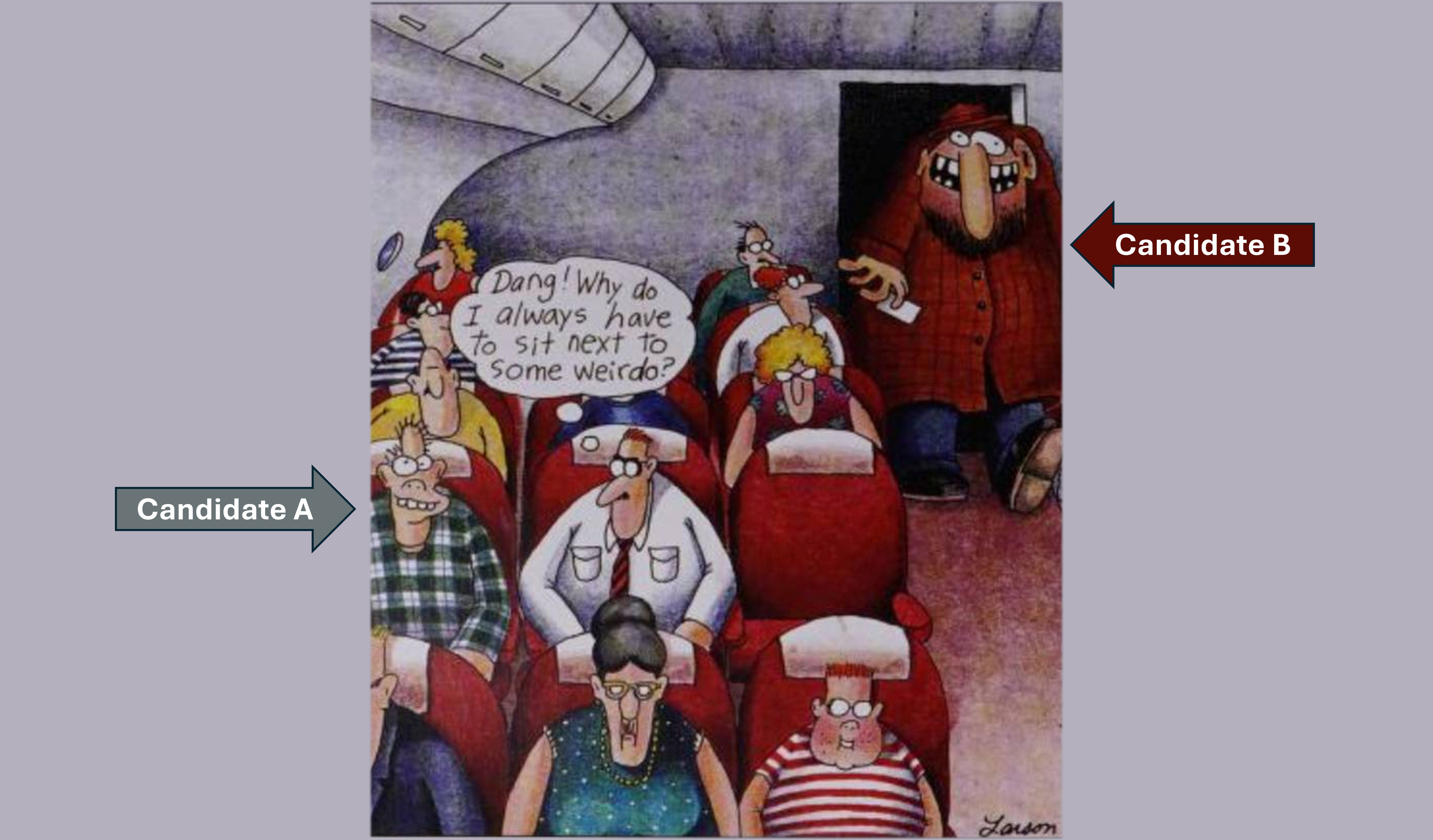
Another reason for Bastiat’s Windows’ eternal non-endorsement stance is that most elections these days remind me of the above classic 1985 cartoon from Gary Larson’s The Far Side. I have many friends and readers who voted for Donald Trump last time and many who voted for Kamala Harris. The aforementioned anthropologists have described sightings of voters who were enthusiastic about each of those candidates, and I have spotted several such people on either side of the aisle with my binoculars. But most of the Harris voters I’ve talked with voted for her primarily because they despised Trump and Republicans; and most of the Trump voters I’ve talked with voted for him primarily because they despised Harris and Democrats. Referring to the cartoon, some saw Harris as Candidate A and Trump as Candidate B, while others saw Trump as A and Harris as B. I have no interest in arguing with purveyors of either viewpoint.
“A Cynic’s Garden of Political Perversities” also described “M.C. Escher Elections,” a situation where, in the words of one sage Bastiat’s Window reader, “the only choice worse than the Republican is the Democrat and the only choice worse than the Democrat is the Republican.” That post also recounted a passage from Douglas Adams’s Hitchhiker’s Guide sequel, So Long, and Thanks for All the Fish. Adams describes a planet where the population is mostly human, but the elected officials are lizards, whom the humans despise. Asked why the humans continue voting for the lizards, one character explains:
“Because if they didn’t vote for a lizard … the wrong lizard might get in.”
And thus, I continue to vote.
REGRET
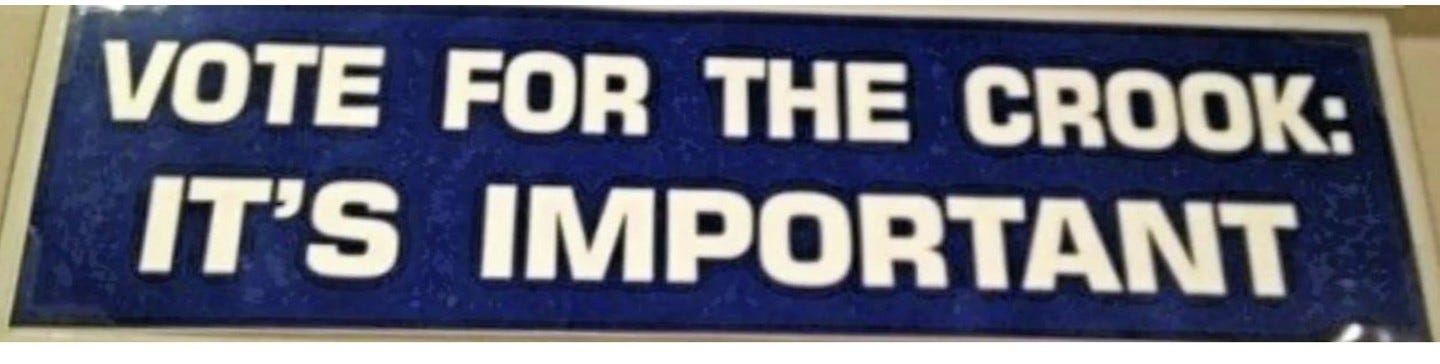
Perhaps my greatest reluctance to endorse candidates comes from fear that I will later regret tying my name to some candidate who later proves odious. For an example: I do not hesitate in the slightest to suggest that in the 2025 New York mayoral election, the oleaginous Andrew Cuomo was (in the Far Side context) Candidate A, whereas his victorious opponent, the malevolent Zohran Mamdani was Candidate B. In 1991, Louisiana’s Governor Edwin Edwards, a wildly corrupt then-former governor, was locked in a tight re-election race with Ku Klux Klansman David Duke. Across the state, cars were plastered with bumper stickers proclaiming “VOTE FOR THE CROOK: IT’S IMPORTANT” —and they helped send the Klansman off to a much-needed retirement. The same bumper sticker, or something along similar lines, would have been entirely appropriate in the 2025 New York election—and, in my estimation, Mamdani is even more dangerous than David Duke ever was.
So why, then, didn’t Bastiat’s Window offer a similar hold-my-nose endorsement of Cuomo? Had I thought there was even an infinitesimal chance that this newsletter could sway the election, I would have deviated from my universal non-endorsement stance and screamed to the Heavens about the monstrosity that is Mamdani. I held no such delusion, however, and simply wished to avoid tying my name to an odoriferous candidate like Cuomo. (Recall my FUTILITY motive above, too.)
My desire to avoid regret dates back to the late 1970s. I was a minor Democratic Party official in the early 1970s and endorsed the then-nearly-unknown Jimmy Carter a full two years before his election. For a brief while after November 1976, I enjoyed the reputation as someone who had seen Carter’s possibilities before most others had.
My prescience, however, turned to extreme regret during Carter’s feckless handling of the 1979-1980 Iran Hostage Crisis. In “Bull Moose versus Weak Horse,” I described how, faced with a similar situation 75 years earlier, Theodore Roosevelt delivered his iconic “Perdicaris alive or Raisuli dead” ultimatum. With no bloodshed or national humiliation for America, Roosevelt intimidated the brigand Raisuli into releasing the American hostage, Perdicaris, (and his son-in-law) almost immediately. Carter, on the other hand, fell to his knees and hid in the Rose Garden for the remainder of his term, begging the Iranian authorities to please-please-pretty-please get our hostages out. In an earlier Bastiat’s Window, I wrote that had Carter acted in the manner of Teddy Roosevelt:
Given Iran’s honor/shame ethos, Iranians would almost certainly have overthrown the government and perhaps hanged the Ayatollahs from the construction cranes that they’ve used for gay people and dissidents ever since. Iran would have been in no position to construct and fortify Hezbollah, Hamas, the Houthis, and the Iraqi and Syrian regimes over the next 45 years.
Decades later, Osama bin Laden famously said: “When people see a strong horse and a weak horse, by nature they will like the strong horse.” Carter, the weak horse, bridled for fourteen months, and Iran did not free the hostages till fifteen minutes after he was deposed by Ronald Reagan, whom the Iranians saw as a strong horse.
Whatever good intentions Carter possessed, his weakness empowered the ayatollahs and enabled them to survive to this day. The carnage on the streets of Iran in 2026 is yet another legacy of that strategic failing. For four-and-a-half decades, I have deeply regretted my endorsement of Carter. Call it what you like, but I have no interest in or need of making another public error of that magnitude.

YOU FILL ME WITH INERTIA
If you are a presidential candidate and wish to seek the endorsement of Bastiat’s Window, here is my response, offered By Drimble Wedge and the Vegetations (Peter Cook in the 1967 film, Bedazzled).
I empathize with your sentiments. However I would point out that many years ago, Robert Heinlein--no fool--was asked for some political advice by a friend.
I won't replicate his entire answer in full, but part of his view was that there aren't always candidates you want to vote *for*. but there's always candidates you'll want to vote *against*.
So in that sense, your observations regarding the last election suggest that those you encountered followed this Heinleinian logic. And I see nothing wrong with that.
I would add that this logic does not apply only to general elections. It applies in primaries as well. Bill Buckley, notably, recommended a simple rule for conservatives registered as Republicans--most were even in those days, but the parties hadn't yet reached the level of ideological conformity that plagues us today--which was: vote for the most conservative candidate whom you deem electable.
In other words, he advocated *against* ideological purity on the basis that if you vote for someone ideologically pure but unelectable...well, you can fill in the rest.
We still see this sensibility at work today as both left and right ideologues saddle up to "primary out" *elected* members of their ideologically-predisposed party whom they deem insufficiently subjugated to the ideological line. Sigh...
Reminds me of a joke from the early 1990s — Edwin Edwards and David Duke were out in a boat on Lake Pontchartrain. The boat capsized, who was saved? The State of Louisiana.