
Endorsements versus Influence
On reader responses to "Electile Dysfunction"


My post of February 3, “Electile Dysfunction,” discussed why Bastiat’s Window has never endorsed political candidates. Readers offered interesting comments and queries, and I’ll respond to a few here. They included: Shouldn’t I hold my nose and endorse the more appealing (or less appalling) choice? Why not endorse a nobler third candidate? Am I in Pauline Kael-Bubble Mode? There were also some worthy comments on the essay’s title, crickets versus grasshoppers, bodily fluids, and Robert Heinlein’s youthful leftist dalliance. Here we go:
FENCE-SITTERS AND WARM SPIT
S’NAUT RIGHT (Instapundit.com): Fence sitters and warm spit. Nobody likes either.
… If one cannot decide [between Trump and Harris] then they’re really just saying they want to look chic and cover for cowardice.
I had no trouble deciding what to do with a ballot pitting Donald Trump against Kamala Harris and some third-party options. But turning those private thoughts into a public endorsement wouldn’t alter a single Bastiat reader’s vote and would greatly undermine my ability to influence readers’ thinking on policies (e.g., Trump’s awful tariffs, Harris’s vile threats to Israel) and on personalities (e.g., Trump’s impulsiveness and demagoguery, Harris’s cluelessness and lack of accomplishments).
Over many decades, my metier has been influencing thinking on narrower questions of policy and politics. Here are two examples. As a DC policy advisor, I was publicly anti-Obamacare, but also deeply skeptical about Republican counter-proposals. (See “Why Both Sides Are Losing the Health Care Debate,” 2014.)
EMAIL FROM STUDENT: In 2013, a left-of-center graduate student and nurse, wrote to say (paraphrasing): “I enjoyed your class. I know it wasn’t your intention, but your lectures made me understand for the first time why some people are fearful of too much government involvement in healthcare.” Of course that perception was my intention. But my approach is to provide facts and let audiences reach their own conclusions. Had I told them: “You SHOULD fear too much government involvement in healthcare,” this student and her her classmates would have steeled themselves against my arguments and rejected them. Had I begun that semester by endorsing, say, Marco Rubio for president in 2016, my capacity to change her mind and the minds of other students on healthcare legislation would have evaporated.
COMMENT FROM CONGRESSMAN: In 2017, a prominent left-wing Congressman wrote me out of the blue (yes, pun), saying he liked something I had written and asked whether I’d speak to around 50 House staffers with whom he worked on healthcare. After my lecture, the Congressman told me he was intrigued by my arguments and wrote later to say that his staff praised what I said. Had I begun the lecture by, say, endorsing Donald Trump’s re-election bid, the Congressman and staffers would have walked out before I spoke further.
I don’t make the futile the enemy of the possible. I treat Bastiat’s Window readers the same as I did those students and Congressional audiences. I offer fragmentary evidence and let readers/listeners draw their own conclusions—perhaps influencing their future votes. Explicit candidate endorsements would wreck those efforts.
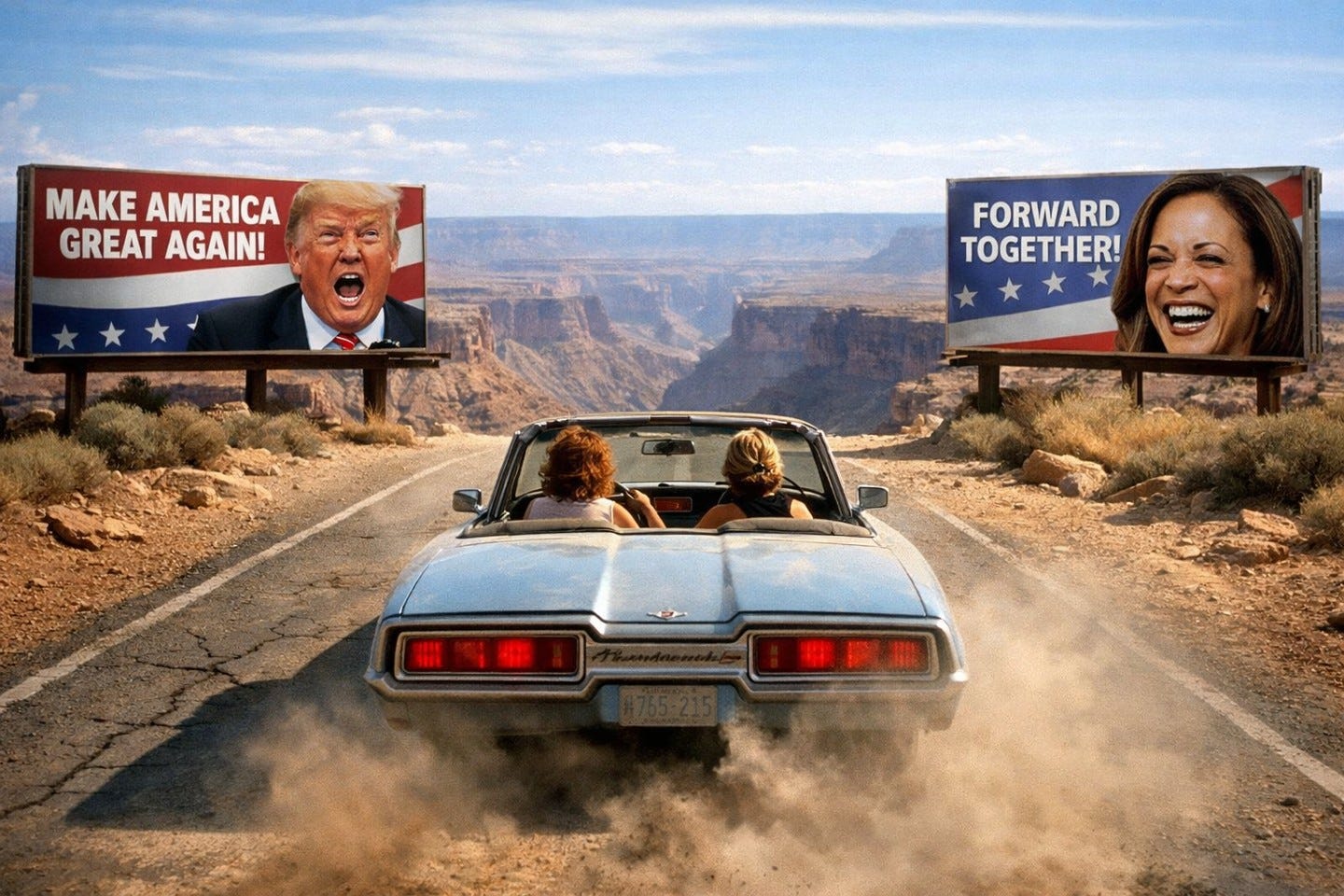
Offering candidate endorsements here would be roughly as effective as handing a driving safety brochure to Thelma and Louise en route to the Grand Canyon.
As for S’NAUGHT RIGHT’s comment, I recently cited a famous quote referring to “warm spit.” In fact, Bowdlerizers used “spit” to replace another bodily fluid in the quote. Scroll down here for the story.
WHY NOT SLIWA?
DOCTOR WEASEL (Instapundit.com): “In the New York mayors race, [Graboyes] couldn’t stand endorsing Cuomo. That I understand, but ... there was another candidate, a Republican. Why not endorse Sliwa? Didn’t like his choice of clothing?”
I heartily approve of Sliwa’s sartorial choices—especially the Guardian Angel beret. But his candidacy was quixotic, garnering only 7% of voters—almost the margin between Mamdani and Cuomo. Had Sliwa dropped out and joined forces with Cuomo, New York might have been spared four years of Mamdani’s Marxist Madness and Israel-hatred; Sliwa might have become a top advisor to an icky but tolerable Mayor Cuomo.
CRICKETS RATHER THAN GRASSHOPPERS?
WILLIAM MATTHEWS (Bastiat’s Window): Mamdani and the Democratic Socialists of America aren’t crickets. They’re grasshoppers. They will multiply and denude the field of all the grass. What will the cows do then?
I imagine Burke would have enjoyed this variation on his epigram.
HOW ABOUT JO JORGENSEN FOR PRESIDENT?
GARY ANDERSON (Bastiat’s Window): I heard Jo Jorgensen speak. She was thoughtful, organized, projected strength & self control and made sense on so many dimensions. … I believe she was on ballots on all 50 states. [Graboyes] and others could have voted for her. Almost everyone chose not to.
Countless Bastiat’s Window readers are thoughtful, organized, and project strength and self-control—and their chances of becoming president in 2024 were identical to the probability of the Libertarian nominee becoming president. Jorgensen was the candidate in 2020, not 2024. (I had to look that up.) 2024’s Libertarian nominee was Chase Oliver, about whom I knew less than nothing—and who garnered less than 1% of the vote. I voted Libertarian once, long ago—a middle finger extended to the two major parties within the privacy of the voting booth. I have some libertarian inclinations but dislikwe the Libertarian Party’s endless marijuana buzz, isolationist policies, and fondness for the unreadable Ayn Rand.
In 2014 Professor Richard Epstein wrote “My Rand Paul Problem”—a fine exploration of the distinction between libertarians and classical liberals. I’m more of the latter.
AM I A NEO-PAULINE KAEL?
ANDY G (Bastiat’s Window): “[M]ost of the Harris voters I’ve talked with voted for her primarily because they despised Trump and Republicans; and most of the Trump voters I’ve talked with voted for him primarily because they despised Harris and Democrats.” … [W]ith the above quote you have painted yourself as a ‘Richard Nixon? Richard Nixon?!? I don’t know anyone who voted for Richard Nixon.’”
After Nixon’s 1972 landslide, New Yorker film critic Pauline Kael was unfairly perceived as the ultimate bubble-dwelling left-winger, thanks to an apocryphal quote attributed to her:
“I can’t believe Nixon won. I don’t know anyone who voted for him.”
Kael was a cloistered New York art-world provincial, but her actual quote was more self-aware—and creepier:
“I live in a rather special world. I only know one person who voted for Nixon. Where they are I don’t know. They’re outside my ken. But sometimes when I’m in a theater I can feel them.”
Unlike Kael, my friends and readers include plenty of people from both parties. Maintaining credibility with both sides requires me to avoid futile partisan breast-beating, empathize with both sides, and limit my writing to topics where persuasion is possible.
TOO COOL FOR SCHOOL?
ANON-INBT (HotAir.com): “I subscribe to [Graboyes’s] Bastiat’s Window. He has great observations on economics, but his politics are that too cool for school academic detachment which ruins a country. Lotus leaf eater. His observation that almost no undecided voters exist in 50 mile radius of DC is probably true, but not true [of the] rest of the country. It’s the old ‘Nixon won? How? I don’t know anyone who voted for him!’ Scott Presler’s door-to-door canvasing and get out the vote efforts probably delivered Pennsylvania for Trump.”
I do not now, nor have I ever eaten lotus leaves. No one actually knows which plant the Greek myths referred to, but if anyone finds out, that plant will be a focus of the next Libertarian Party platform.
Most Bastiat’s Window readers are highly opinionated and motivated—not the undecided and apathetic voters whose doorbells Scott Presler rang.
HEINLEIN AND SINCLAIR, JOHNSON AND HITLER
DAVID (Bastiat’s Window): “[P]art of [Robert Heinlein’s] view was that there aren't always candidates you want to vote *for*. but there's always candidates you'll want to vote *against*.”
JOHN OLSON (Bastiat’s Window) “Robert [Heinlein] ran for the California Assembly as a supporter of Upton Sinclair's End Poverty In California campaign.”
Olson noted that Heinlein ran for office in the 1930s on Upton Sinclair’s socialist-adjacent agenda. As I replied:
“[A] lot of people in that era veered into the crazier [precincts] of American politics. The architect Philip Johnson spent the 1930s as an admirer of Hitler. He wrote a glowing review of Mein Kampf. He witnessed Germany’s invasion of Poland and described it as ‘a stirring spectacle.’ In the 1950s, he designed a synagogue and charged no fees for his work—as an act of atonement.”
I’m sympathetic to those who sincerely renounce youthful ideologies. Like ex-Communist Whittaker Chambers, they can be especially eloquent advocates.
DID I STEAL THE PUN “ELECTILE DYSFUNCTION” FROM THE CAPITOL STEPS?
DONH (Hot Air.com): “The Capitol Steps comedy troupe used this as a title for a song back in, oh, 2012??”
I was never a Capitol Steps fan and didn’t know they used this pun. In fact, the song dates from 2004—the same year writer/director David Burrows released his documentary, Electile Dysfunction. I know nothing about the film, and little about Burrows. As for my theft of this aging pun, I’d say, “There is nothing new under the sun,” But then I’d be plagiarizing the 3,000-year-old Book of Ecclesiastes.
DYSFUNCTION: FIGURATIVE AND LITERAL
DOOGELS (HotAir.com) “This story leaves me limp.”
I have no idea whether Doogels liked or disliked my essay, but as for his comment—“Huzzah!”

WARM BODILY FLUIDS
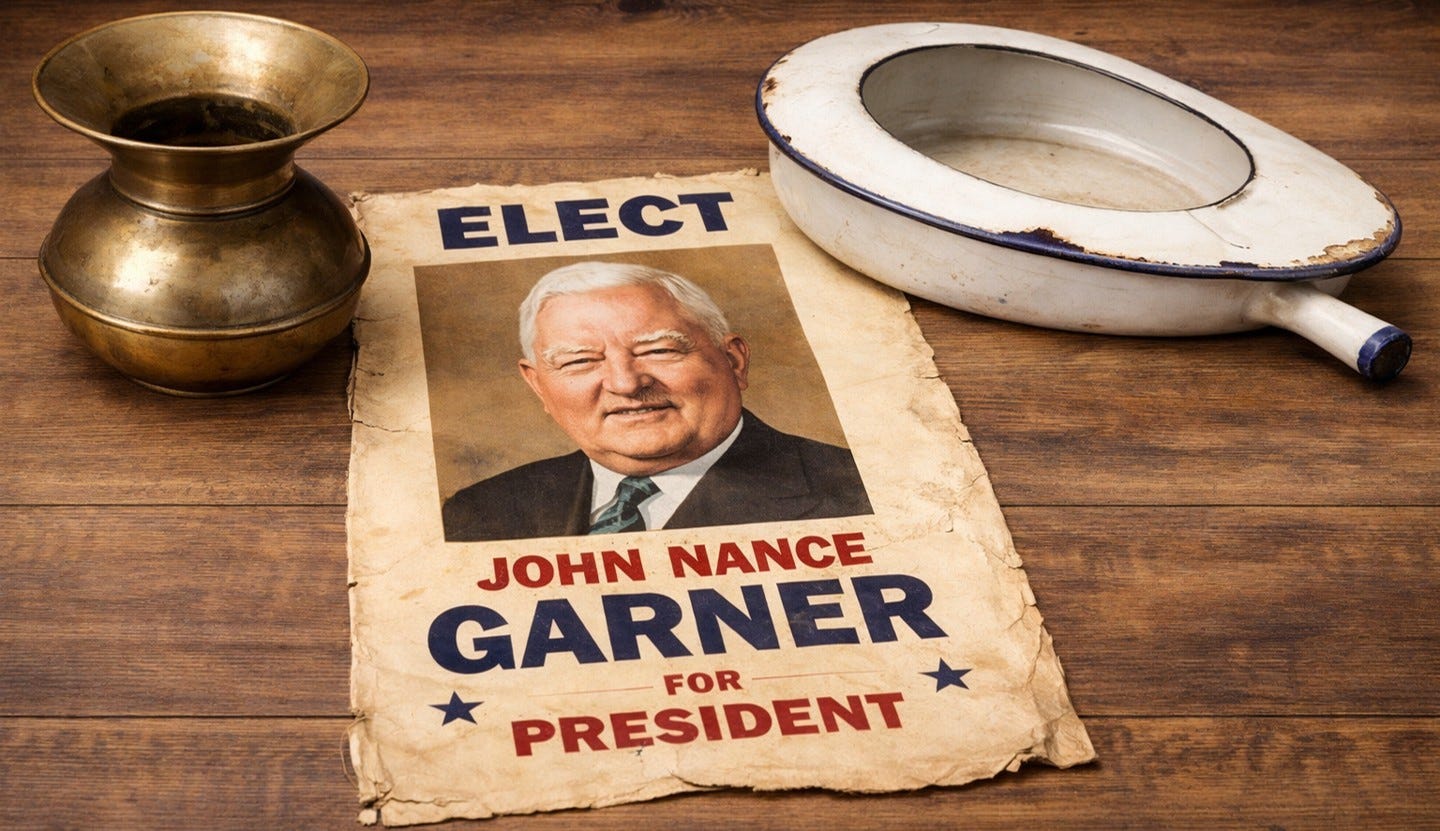
John Nance Garner, FDR’s first VP, is often quoted as saying the vice presidency wasn’t “worth a bucket of warm spit,” but the word “spit” was likely a Bowdlerization. The prickly Texan almost certainly said “warm piss.”
Endorsements matter if they come from reputable endorsers. Newspaper and media endorsements do not matter much anymore
I spent nearly 30 years teaching Public Budgeting (at the local and state level) and various policy courses and few students ever managed to discern my personal preferences. As one grad student told me, at the end of the course (paraphrased), "None of us cant tell what your politics are. We do think you're crazy and you know a lot, but you find bad things to say about every possible choice."
I told her that made me think I was doing it right. People who want whatever choice they favor tend to tell you only good things that come from that choice, and bad things from the choices of others. It is better for you to try to find the bad things about any choice then decide if the trade-offs are worth it.