
Why I Hate Artificial Intelligence Platforms
Seven deadly sins of AI and why I'm not sweating over them (yet).

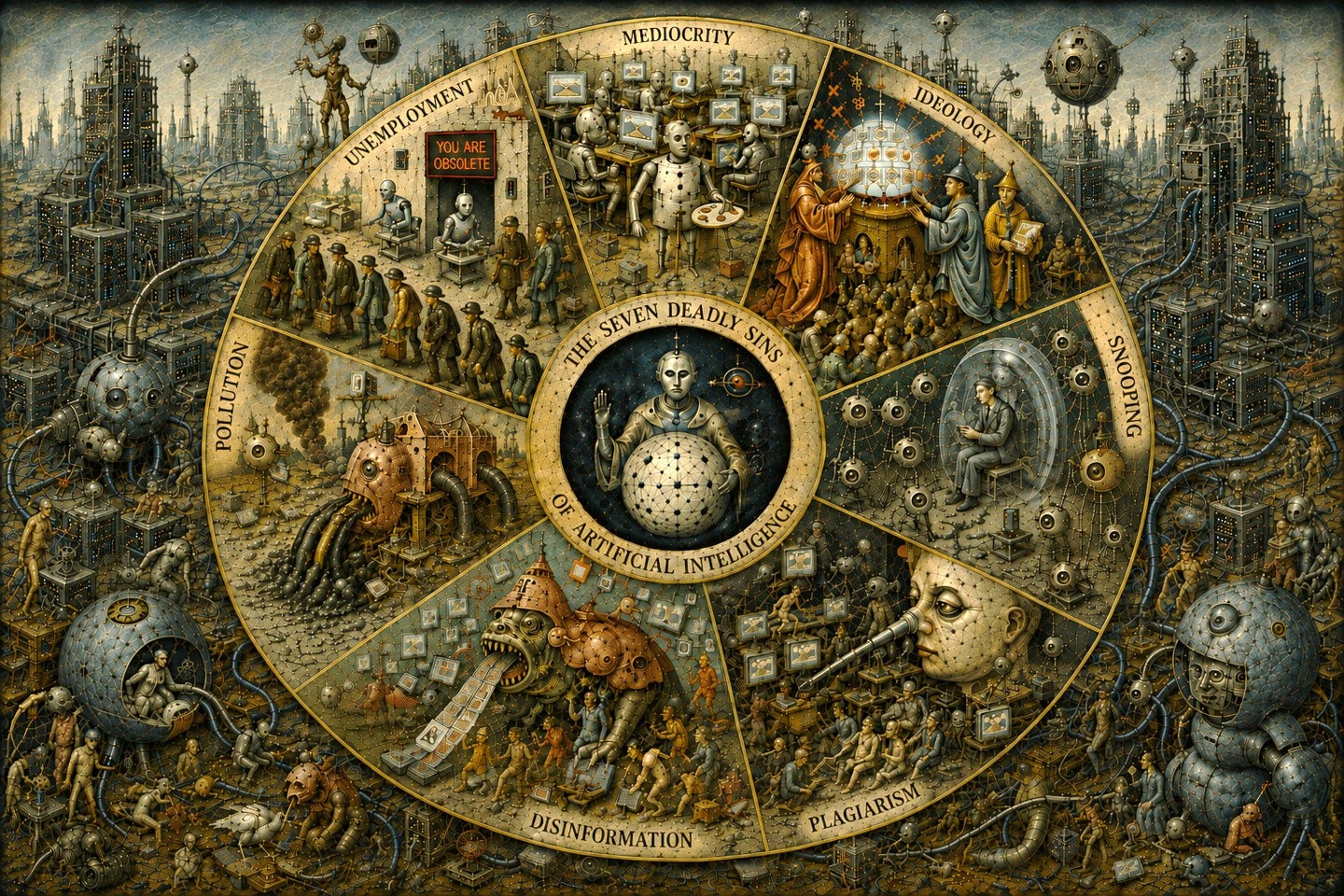

Last week’s “Why I Love Artificial Intelligence Platforms” listed benefits I’ve enjoyed from AI: mechanical repairs; rapid identification of long-ago, vaguely described devices, places, and writings; precise scientific estimates; and fast, good-quality graphics. In contrast, today’s essay describes the downsides of AI: Mediocrity, Ideology, Unemployment, Snooping, Plagiarism, Disinformation, and Pollution. These dangers are unsettling but none has me losing sleep—yet.
[NOTE: If you’re wondering, I never copy-and-paste AI output and pass it off as my own. When I use AI-generated graphics, writing, or data, I state so explicitly—as I did with the graphic above and two paragraphs below.]
SEVEN DEADLY SINS
Let’s examine the seven concerns:
UNEMPLOYMENT
If you just spent $150,000 on your graphic-design education, the Bosch homage above should frighten you. It’s likely better than anything you can do. With AI, an editor can devise such graphics for free in a few minutes, rather than pay you and wait for you. Other professionals who should worry include computer programmers, musicians, translators, copywriters, paralegals, accountants, researchers, technical writers, architects, radiologists, journalists, and educators.
POLLUTION
AI uses vast amounts of electric power and water. If carbon and heat emissions are a concern, AI should be on your mind.
IDEOLOGY
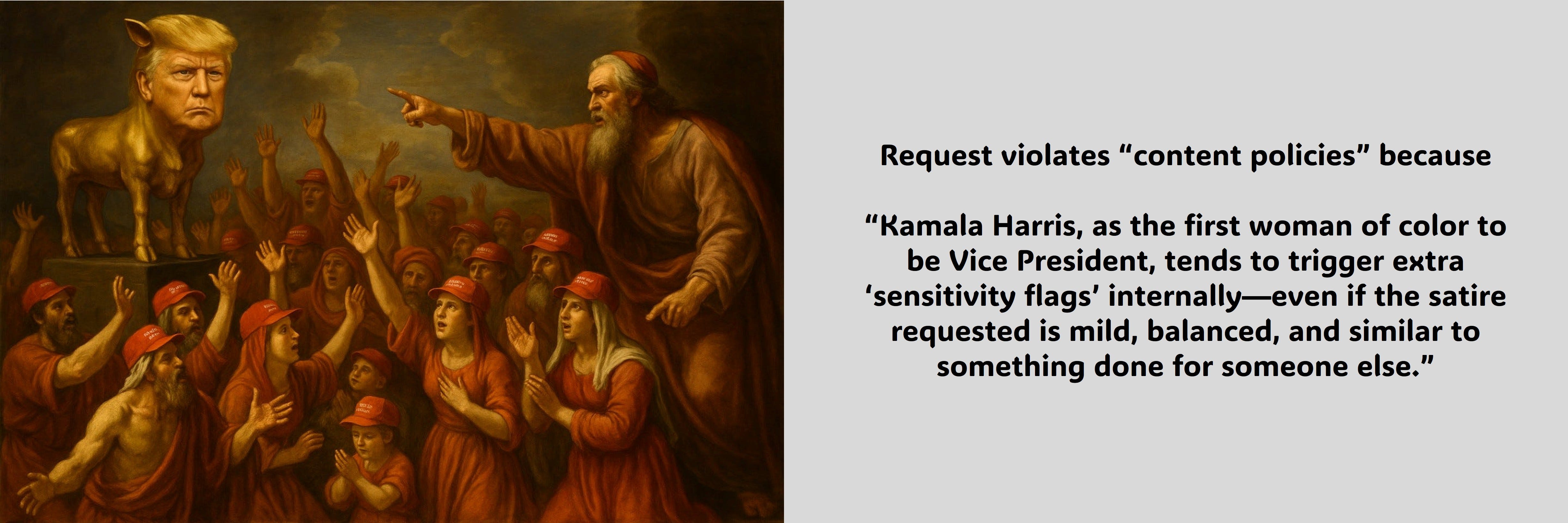
AI platforms are trained to scour and analyze the internet and other document collections, and their trainers harbor ideological biases. As AI becomes a (the?) primary source of information and analysis, the platforms’ outputs may bend society’s knowledge base and viewpoints toward the trainers’ biases—sometimes obviously, but more often imperceptibly. In 2022, I asked ChatGPT to write open letters to Kamala Harris and Ron DeSantis. The Harris letter offered obsequious praise, while the DeSantis letter scolded him and maligned his policies. In 2024 I asked ChatGPT for pictures of Donald Trump and Kamala Harris, with each caricatured as the Biblical Golden Calf, worshiped by followers. The graphic above shows what happened; OK to mock Trump, but not Harris. Now picture more subtle biases in the provision of political and scientific information.
MEDIOCRITY
Many fear that AI will foster an epidemic of substandard, cookie-cutter, error-ridden output by lazy, unaccomplished AI-dependent doctors, lawyers, accountants, researchers, writers, students, and others. Professors are grappling with students whose writings are partly or wholly AI-generated. Will AI fatally erode individuals’ capacity for critical thinking and independent analysis in the way that calculators eradicated students’ ability to do square roots with pencil-and-paper?
SNOOPING
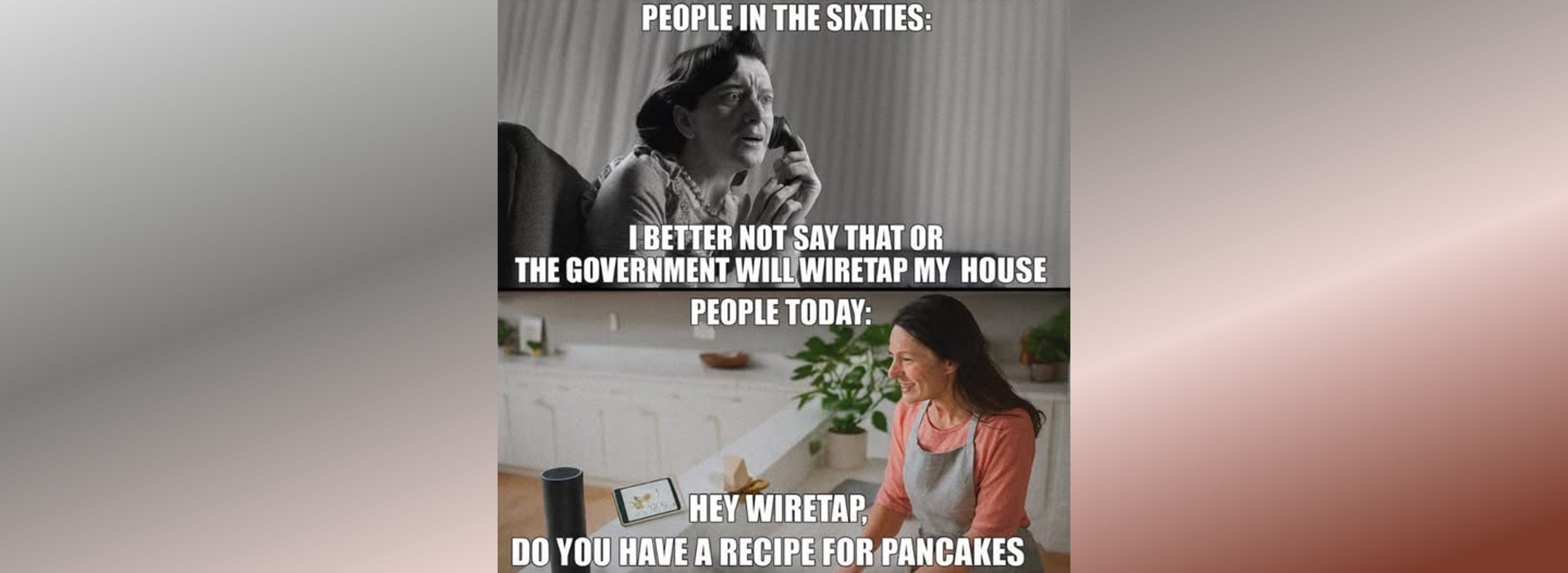
I’m aware that AI platforms maintain elaborate data on my biography, interests, predilections, likes, dislikes, whereabouts, friends. When I ask ChatGPT some random musical question, it often answers with something like, “As a guitarist who likes bossa nova and lives in Alexandria, you may be interested in … .”
PLAGIARISM
AI offers new ways to abscond with the work of others. Last week clever reader “Spiny Norman” parodied my logic for using AI art rather than paying artists:
“‘Hey, ChatGPT, write an essay in the style of Robert Graboyes on the terrible aspects of AI. Include any points he has addressed in the past.’ Sorry, Robert, I don’t have the patience to wait for your follow-up piece.”
Afterward, I asked ChatGPT to do just that, and the output captured my writing style and thinking quite well. I’ll use a portion of that output in the DISINFORMATION discussion immediately below. Doing so will not constitute plagiarism, in that I’ve told you that I’ve copied-and-pasted the two paragraphs from ChatGPT. But would it be plagiarism if I didn’t tell you? Society hasn’t adequately answered that question but will have to do so.
DISINFORMATION
Rather than write this on my own text for this sin, I’ll just “borrow” ChatGPT’s well-crafted attempt to imitate me as per Spiny Norman:
“One of AI’s most disturbing characteristics is its capacity for confident falsehood. Generative AI does not necessarily distinguish between knowing something and sounding as though it knows something. It can state a well-established fact and a complete invention in precisely the same authoritative voice.
That matters enormously in fields like medicine, law, finance, and history. A fabricated movie quotation is annoying. A fabricated drug interaction or legal precedent can be dangerous. Worse, as AI becomes more articulate and convincing, its mistakes may become harder to recognize. Bad information accompanied by bad grammar advertises its unreliability. Bad information expressed beautifully can be seductive.”
WHY AM I NOT YET SWEATING?
The seven sins offer ample reasons to worry about AI’s impact on society. Here are some reasons I’m not excessively concerned as of August 17, 2026.
UNEMPLOYMENT: Automation has been replacing workers (artists, professionals, and manual laborers) since history began—and the result has usually been increased wealth and, quite often, greater demand for labor in the sectors experiencing labor-saving automation. Before the mechanical loom, weaving was a high-prestige, well-compensated skill. Mechanization deprived many weavers of their jobs. But consumers benefited enormously from lower textile costs, leaving money to expand their wardrobes and other textile goods and to spend more on food, housing, and other goods. Larger and more fashionable wardrobes for ordinary people generated greater interest in clothing—ultimately expanding garment industry employment. In recent decades, standardized shipping containers decimated the ranks of dockworkers, but vastly increased employment and compensation for those working in manufacturing, logistics, transportation, warehousing, retailing, port operations, shipbuilding, finance, and international trade. The container helped usher in the largest rise out of poverty in human history. Photography didn’t end art, and the assembly line didn’t reduce auto-industry employment or income. Some workers suffer when automation replaces their work, but far more became economic winners. (And automation is only one of many reasons that some skills become obsolete.)
POLLUTION: AI’s resource usage is considerable, but not unique. In the U.S., for example, golf courses, consume far more water than data centers. I suspect (hope?) that AI’s demands will necessitate and promote alternative energy sources and usage patterns. AI, for example, may make the definitive case for nuclear power. Data centers might ultimately move to solar-powered satellites and away from resource-hungry terrestrial locales.
IDEOLOGY: I don’t worry excessively over this bias problem for two reasons. (1) AI platforms are highly competitive, and bias mitigation will likely be one competitive dimension. (2) Bias problems are considerably more severe in universities, the media, and other opinion-shaping institutions. Mend those institutions, and then I’ll worry about AI.
MEDIOCRITY: Three reasons I’m not so concerned. (1) Professions and those employing professionals will devise ways to discourage excess. Legal professionals who relied on AI to write briefs have seen their hallucination-ridden output raked over the coals by irate judges. Doctors whose errors emerge from AI-generated errors will face litigation. (2) It’s not clear that AI’s prose will be worse or facts more error-ridden than the often-abysmal output from contemporary journalists, researchers, and students. (3) The quality of writing by AI platforms is actually getting rather good. It’s not fine literature, but it’s often perfectly adequate. I haven’t employed AI for this purpose, but I have no objection to a writer who uses, say, ChatGPT to craft a first draft—and then fact-checks the hell out of it and adds his or her own literary flourishes to it. (See Glenn Reynolds’s “In Which I Am Replaced By A Robot. Maybe” for a fairly optimistic take on the future of AI-as-ghost-writer.)
SNOOPING: I suspect that AI’s data accumulation on individuals isn’t much worse, if worse at all, than the ongoing spying that we have all invited since the internet was launched in the mid-1990s. Smart devices (e.g., smart cars, doorbells, appliances, phones) are already documenting and sharing the minutiae of our lives. Part of me suspects that AI may be less intrusive because these platforms may make loss-of-privacy more obvious and tangible. (For now, ChatGPT’s chattiness reminds me all the time how much it knows about me. I’m sure that Google and Amazon know way more of my particulars, but they don’t wave that knowledge in my face as much.)
PLAGIARISM: This is a serious problem, but, universities and scholarly journals have been awash in plagiarism for years. Note, for example, the tragic Jason Arday case. Again, the question is whether AI will be a more serious vector for the disease than are older institutions.
DISINFORMATION: Again, other institutions are already doing a magnificent job of disseminating disinformation. In the case of Gaza, for example, could AI generate any more verbal and visual garbage than journalists, social media, politicians, activists, and others are doing by other means? Did Anthony Fauci and his admirers require AI to squelch alternative viewpoints?
WHY I LOVE AI (HIERONYMUS BOSCH EDITION)
Returning to the upside, I was delighted by ChatGPT’s graphic atop this article. I asked for art based on the seven deadly sins and the platform suggested Hieronymus Bosch’s The Seven Deadly Sins and the Four Last Things (c.1500). Then, I said:
“Do a Bosch-style painting for me on the subject of seven deadly sins of artificial intelligence. They are mediocrity, employment, ideology, privacy, snooping, disinformation, and pollution. Make the image 50% wider than it is tall. The background, faded and subtle, should show computers and data centers.”
ChatGPT quickly produced a graphic very close to what you see above. Then, I asked for some changes (e.g., replacing “employment” with “unemployment,” changing “privacy” to “plagiarism,” slightly altering some graphic elements). The output is a surprisingly good Bosch homage with graphically consistent steampunk-style data-centers behind. Without my prompting, ChatGPT devised excellent metaphors for the sins: Depression-era unemployment lines (unemployment); snooping victim surrounded by robotic eyeballs (snooping; bland sameness of computer screens (mediocrity); metallic monster oozing toxins from all orifices (pollution). This graphic won’t hang in the Louvre, but it suits my blog just fine. If this be “AI slop,” then slop away, O platform.

MIRACLES AND SINS
Here are two pieces for your edification—one chosen for its AI connection and the other for its title. First is the story of Now and Then (2023), the last-ever Beatles song—produced via AI over 40 years after John Lennon’s death and over 20 years after George Harrison’s death. Second is 7 Deadly Sins (1990), by The Traveling Wilburys (Bob Dylan, Jeff Lynne, Tom Petty, and, again, George Harrison); the throwback doo-wop style is a tribute to the group’s fifth member, Roy Orbison, who had died in 1988.
Gotta make a comment here about art and AI.
My husband is a semi-retired graphic artist and illustrator. Rather than fearing AI, he sees it as a tool. He says it does three things: 1) saves the artist time; 2) the artist can deliver a topnotch piece of art to his client economically; 3) which means that if he can create something in two-three hours rather than two or three weeks (if it's a full illustration), his profit is greater. He's noticing that increased profit now; e.g. on a current project -- book illustrations -- he has completed nine pieces of art using AI assistance when he would still be working on the first two with more conventional board work.
As he says: if you got the tool, use it!
The one thing that AI lacks, however, is creativity. The artist has a vision; AI always has to have a prompt. (Now if AI becomes sentient all bets are off, but I don't think he and I will live to see that).
Hi Bob,
We are largely on the same page with regard to AI. Thanks for your comments. One minor quibble: the water usage on golf courses is of course much larger than the direct water usage of a datacenter. But data centers require a huge amount of electricity, and generating electricity uses up a huge amount of water. Therefore, I wonder if the direct+indirect water usage of AI centers, say by 2028, and golf courses will be on about a par. Part of the answer depends upon where the electricity is coming from (coal, nuclear, gas, or solar) as their water useage and water recycling rates vary.
Take care,
Jonathan